When I first launched GT Manager, I was genuinely excited because the concept immediately appealed to me. Motorsport management games have always been a niche genre, and focusing entirely on endurance racing is something that feels fresh. Taking control of a racing team, developing facilities, signing drivers, researching new technologies, and making split second strategic decisions during long races sounded like exactly the type of experience I wanted. After spending many hours with the game, I found myself enjoying several aspects of the management loop, but I also couldn’t ignore the many limitations that prevent GT Manager from becoming one of the genre’s best.
Building a Racing Empire From the Ground Up
GT Manager begins your journey as the Team Principal of a GT4 racing team before gradually allowing you to climb through five different endurance championships all the way to the prestigious Hypercar category. That progression system gives every season a clear objective, making each promotion feel rewarding as your organization slowly transforms from a small private team into a serious championship contender.
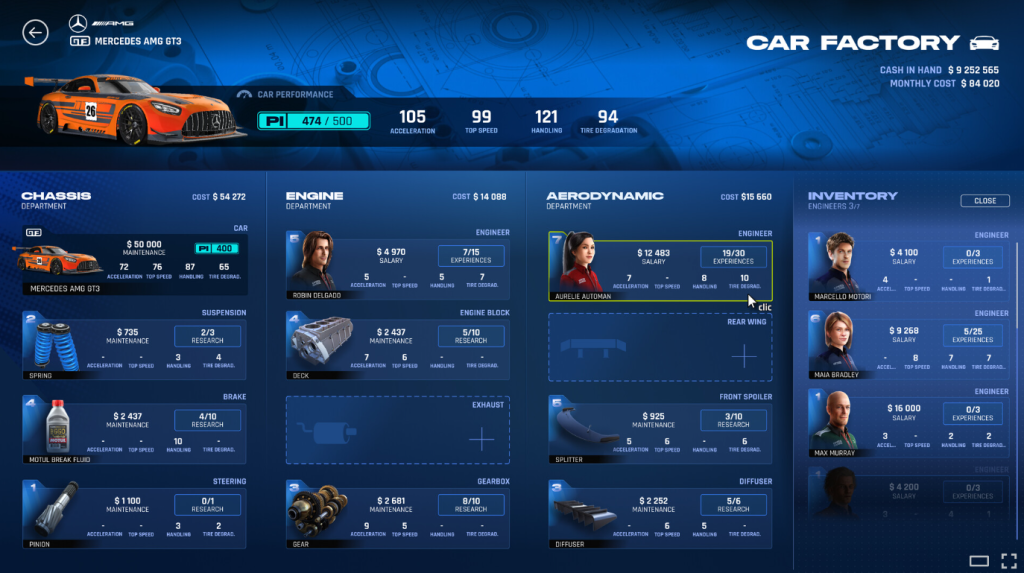
The management layer covers many of the responsibilities you would expect. You upgrade twelve different factory departments, recruit engineers, invest in research and development, scout talented drivers, manage finances, and improve every aspect of your organization. I appreciated that the game avoids overwhelming new players with endless spreadsheets. Instead, it introduces new mechanics gradually, making it one of the most approachable racing management simulations I have played. If games like Motorsport Manager felt intimidating, GT Manager offers a much smoother learning curve without sacrificing the basic strategic decision making.
Licensed Cars, Real Drivers and Authentic Endurance Racing
One of GT Manager’s strongest selling points is undoubtedly its official licensing. The game includes 30 licensed GT race cars from 16 world famous manufacturers, alongside 29 official factory and private teams and a roster of 44 real endurance racing drivers. Unlocking an additional 25 alternative cars through achievements also gives players extra long term goals beyond simply winning championships.
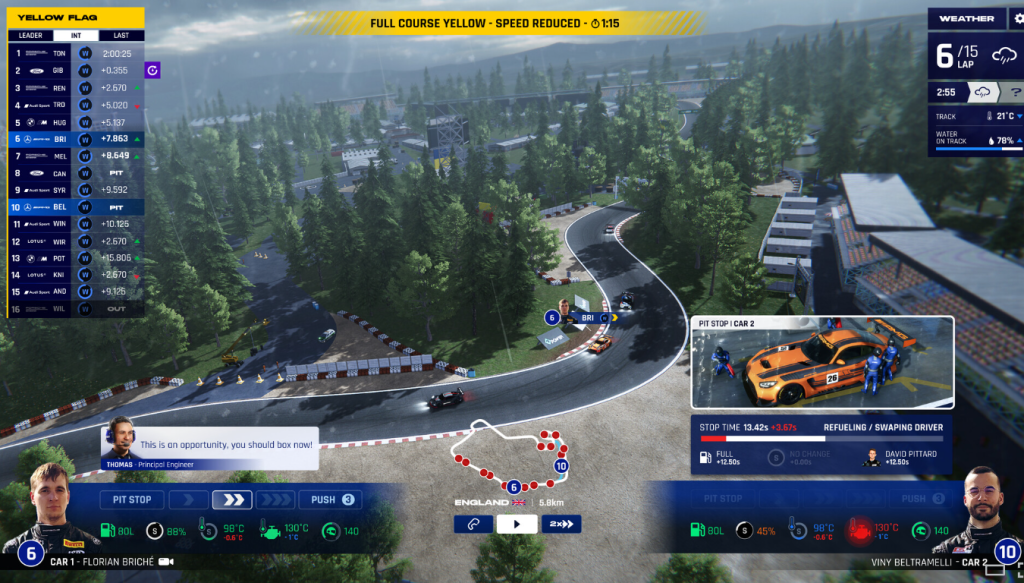
The race weekends include several authentic endurance mechanics that fans of the sport will instantly recognize. Tire degradation, fuel consumption, driver swaps, weather changes, day and night transitions, and pit stop strategy all influence the outcome of every event. Racing takes place across 13 different circuits featuring dynamic weather and real time lighting, which constantly forces you to rethink your strategy instead of simply repeating the same approach every race.
Simple Strategy That Is Fun But Lacks Real Depth
The biggest strength of GT Manager is also one of its biggest weaknesses. Its accessibility makes it easy to recommend for newcomers, but experienced management simulation fans will probably notice how simplified many systems actually are. During my playthrough I repeatedly felt like the game was introducing an interesting mechanic, only for it to end much sooner than expected.
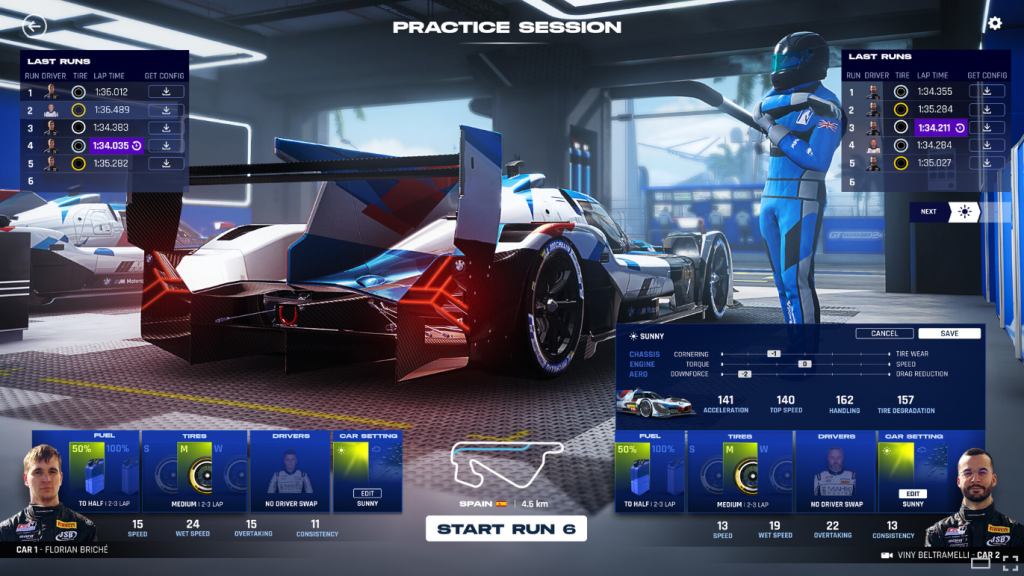
Car development exists through research and upgraded components, yet there is almost no detailed setup system. Before races there are no meaningful suspension adjustments, aerodynamic tuning, gear ratio changes, or tire pressure management. Qualifying is also extremely simplified, requiring little more than pressing a button and immediately receiving the starting grid. I found this particularly disappointing because qualifying strategy is normally one of the highlights of motorsport management games. Here, it becomes little more than a menu transition instead of an engaging tactical challenge.
Race Management Delivers the Best Moments
Despite the simplified systems, I genuinely enjoyed the races themselves. Watching fuel levels, monitoring tire wear, deciding when to pit, reacting to weather changes, and planning driver swaps creates enough tension to keep every endurance race interesting. Longer races especially become enjoyable puzzles where one poor strategic decision can easily ruin several hours of preparation.
The AI performs reasonably well and generally reacts intelligently to changing race conditions, creating competitive battles throughout the championship. The three available difficulty settings also help both newcomers and experienced players find an appropriate challenge. While I would have liked even more strategic options during races, the core management loop succeeds in delivering those satisfying moments where a perfectly timed pit stop completely changes the final result.
Presentation Feels More Like a Mobile Game Than a Modern PC Release
Unfortunately, presentation is where GT Manager loses a significant amount of momentum. Although the licensed race cars themselves are detailed and accurately recreated, nearly everything surrounding them feels underdeveloped. The user interface constantly reminded me of a mobile game rather than a premium PC management simulator, and that feeling never completely disappeared throughout my time with the game.
The control scheme is equally frustrating because the game only supports mouse input. There are no customizable keyboard shortcuts or controller bindings, which makes navigation unnecessarily restrictive on PC. Even stranger, the game repeatedly changes the Windows display size whenever it switches between the factory management screens and race sessions. This may seem like a minor issue at first, but after dozens of transitions it became surprisingly annoying and made the entire experience feel less polished than I expected.
Weak Audio and Missing Features Hold Everything Back
Another area that disappointed me was the overall production quality. The audio design is extremely basic, lacking the excitement and atmosphere that endurance racing naturally provides. Engine sounds, ambient effects, menu audio, and race feedback all feel flat, making the races less immersive than they should be.
Several features also feel noticeably absent. There are no custom liveries for players who enjoy personalizing their teams, camera options are limited, and the overall simulation depth simply never reaches the level expected from a modern management title. Considering the game’s premium price, I expected more complexity, more polish, and faster post launch improvements. Instead, the package often feels unfinished despite leaving Early Access, with some rough edges still waiting for meaningful updates.
Final Verdict
GT Manager is a game that I genuinely wanted to love because the foundation is surprisingly solid. The official licenses, endurance racing focus, accessible management systems, factory progression, and strategic race decisions create an enjoyable experience that is easy to recommend for newcomers interested in motorsport management. I consistently found myself wanting to complete one more championship and unlock the next category, which says a lot about how addictive the core gameplay loop can be.
At the same time, I cannot overlook its shortcomings. The weak audio, limited graphical presentation outside of the cars, missing setup mechanics, shallow qualifying system, lack of customization, restricted controls, and generally mobile inspired design all prevent GT Manager from reaching its full potential. In my opinion, this is a good introduction to endurance racing management rather than the definitive simulation many fans were hoping for. If you are looking for an accessible strategy game with licensed GT content and don’t mind simplified mechanics, you’ll probably have a good time. However, if you expect deep simulation systems and a polished PC experience that fully justifies its price, GT Manager may leave you wishing there was just a little more under the hood.