The automation genre continues to evolve beyond pure efficiency simulators, and AGRONOM emerges as one of the most intriguing new entries in the field. Developed by MindEdges and published by Skystone Games, the upcoming title introduces players to a futuristic Martian colony where robotic automation meets Eastern European cultural heritage. Rather than presenting Mars as a cold technological frontier, AGRONOM blends industrial engineering gameplay with emotional storytelling and handcrafted aesthetics, positioning itself as both a systems-heavy simulation and a personal creative journey.
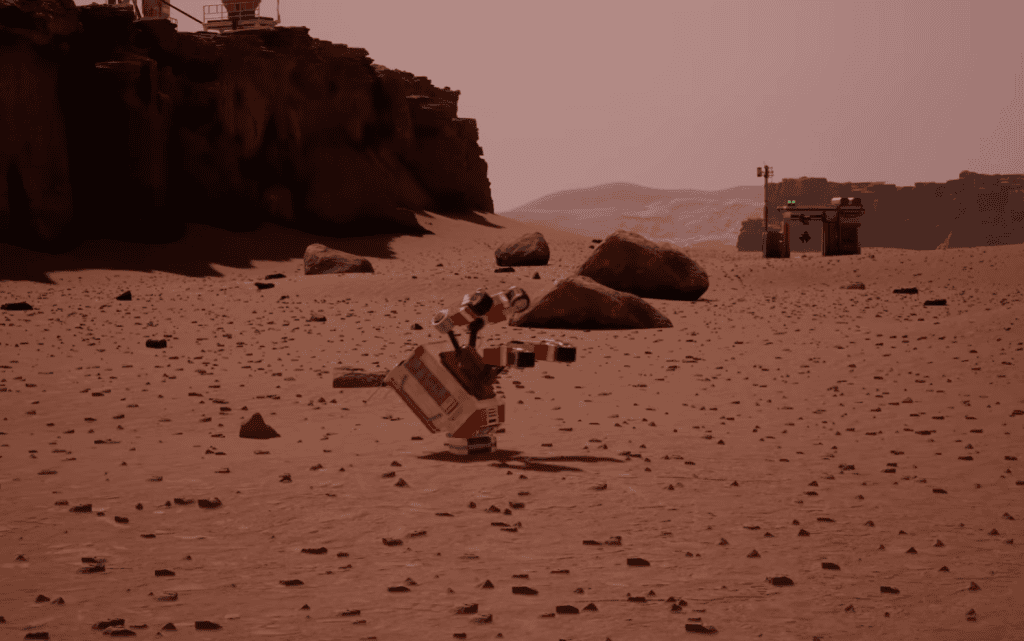
Set in the 22nd century, AGRONOM places players on a barren stretch of Martian terrain armed only with basic tools, autonomous robots, and a memory-driven motivation: fulfilling the dream of building a warm, living home in an inhospitable world. The concept transforms the typical automation loop into something deeply narrative-driven, where optimization is not only about efficiency but about rebuilding meaning and life on an alien planet.
Automation Systems Designed for Depth and Creativity
At its core, AGRONOM belongs to the lineage of complex automation builders inspired by titles such as Satisfactory and Factorio. Players construct interconnected production networks that harvest raw Martian resources, refine materials, and transform them into tools, infrastructure, and agricultural outputs. Conveyor systems, robotic logistics units, automated furnaces, and modular assembly chains form the technological backbone of the experience.
The gameplay loop revolves around scalable industrial design. Early stages begin with manual extraction and small robotic helpers, but progression introduces advanced automation tiers including programmable drone fleets, autonomous greenhouse maintenance systems, multi-stage refining plants, and synchronized transport networks. Production throughput, energy efficiency, and spatial layout become critical engineering challenges, encouraging players to experiment with optimized factory geometries and parallel manufacturing pipelines.
Unlike traditional automation games that emphasize pure productivity metrics, AGRONOM integrates environmental feedback systems. Resource availability varies depending on terrain depth, atmospheric exposure, and infrastructure expansion. Players must balance power consumption, transport latency, and production bottlenecks, effectively turning Mars into a dynamic logistical puzzle rather than a static sandbox.
Terraforming Mars Through Agriculture and Robotics
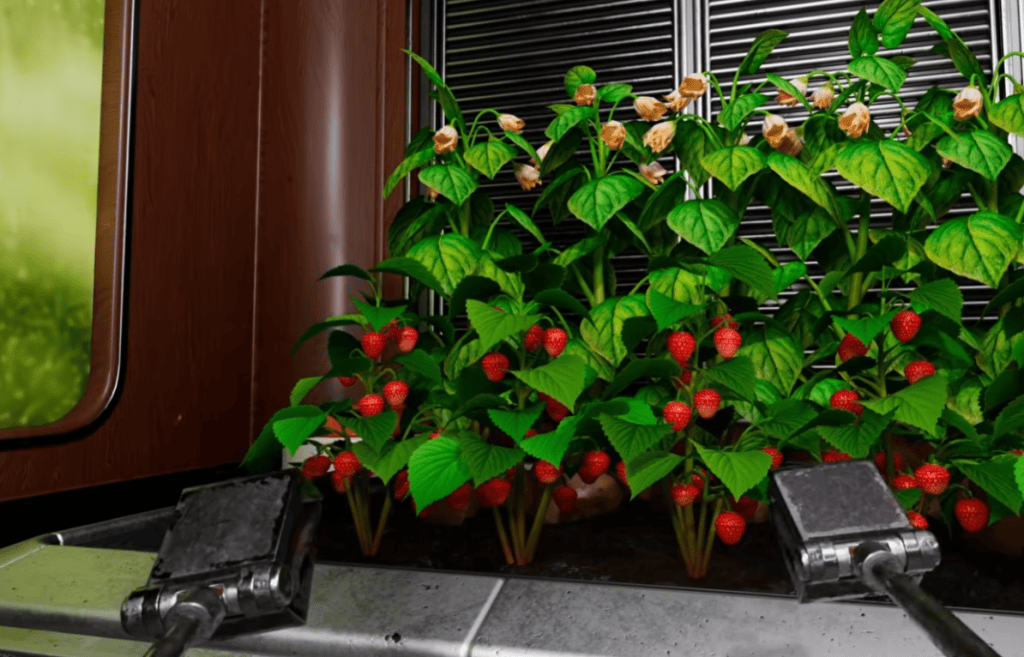
Agriculture plays a central role in AGRONOM’s identity. Instead of mass industrial output alone, the player’s primary mission is to cultivate life itself. Robotic farmers manage hydroponic farms, climate-controlled domes, and soil regeneration systems designed to simulate Earth-like growing conditions within Mars’ hostile environment.
The agricultural simulation introduces layered mechanics including irrigation routing, nutrient synthesis, temperature stabilization, and crop genetics optimization. Players gradually unlock advanced bioengineering modules that allow cultivation of increasingly complex plant varieties, turning sterile Martian regolith into productive farmland. Food production feeds both narrative progression and technological expansion, reinforcing the idea that survival depends on ecological balance as much as mechanical efficiency.
Automation extends into every aspect of farming. Robots sow seeds, monitor plant health through sensor arrays, adjust lighting spectrums, and harvest crops without direct player intervention. The goal evolves from simple food production toward creating a sustainable Martian ecosystem—one where technology serves life rather than replacing it.
A Distinct Eastern European Cultural Identity
One of AGRONOM’s most unique design pillars is its cultural inspiration. Instead of futuristic minimalism, the game draws heavily from Eastern European folk traditions. Bases are decorated with painted wood textures, warm interiors, patterned tiles, and handcrafted visual motifs rarely seen in science-fiction automation titles.
This artistic direction transforms the player’s settlement into more than an industrial complex. Buildings feel lived-in, personal, and nostalgic, reflecting the memory of a lost Earth heritage carried into space. Robots themselves feature personality-driven behaviors and visual customization, reinforcing emotional attachment to the colony rather than treating machines as disposable tools.
Narratively, the player rebuilds a home inspired by family legacy—specifically the dream of creating a thriving, welcoming place filled with gardens and purpose. This emotional framing subtly changes player motivation: optimization becomes an act of care, and expansion becomes an expression of remembrance and identity.
Expanding Across the Martian Frontier
Progression in AGRONOM is tied to exploration and regional expansion across Mars. As production capacity grows, players unlock new zones featuring distinct geological conditions, resource compositions, and environmental hazards. Each new region introduces different engineering constraints, forcing players to redesign logistics networks rather than simply scaling existing layouts.
Energy infrastructure becomes increasingly complex as colonies expand. Solar arrays must compensate for Martian dust accumulation, nuclear or advanced fusion reactors may be required for late-game production chains, and long-distance resource transport introduces latency challenges that require automated scheduling systems and buffer storage management.
The expanding frontier structure ensures that AGRONOM maintains long-term gameplay depth. Instead of a single megafactory solution, players continuously iterate, redesign, and adapt their colonies to evolving planetary conditions, mirroring real-world challenges of off-world settlement planning.
Technology Meets Emotional Storytelling
AGRONOM distinguishes itself through its attempt to merge mechanical mastery with emotional resonance. The narrative unfolds indirectly through environmental storytelling, base development, and interactions with robotic companions. Rather than scripted cinematic sequences, the story emerges through player-created spaces—greenhouses filled with life, warm interiors illuminated against the cold Martian night, and automated systems working harmoniously together.
The game’s pacing encourages reflection alongside optimization. Quiet moments between expansion milestones allow players to appreciate their settlement not merely as an engineering accomplishment but as a symbolic home. This balance between systemic complexity and emotional comfort represents a deliberate departure from purely industrial simulation design philosophies.
By integrating personality, culture, and memory into automation mechanics, AGRONOM aims to redefine what an automation game can emotionally deliver while maintaining the genre’s technical rigor.
Development Vision and Publishing Support
Developer MindEdges describes AGRONOM as an effort to respect both analytical and artistic players—those who enjoy solving logistical puzzles and those who seek creative expression. The studio focuses on deep systemic interactions supported by aesthetic warmth, positioning the project as a hybrid between simulation, strategy, and narrative sandbox.
Publishing support comes from Skystone Games, a global publisher co-founded by David Brevik, known for his role in shaping modern action-RPG design. Skystone has built a reputation for backing unconventional projects and emerging development talent, helping bring distinctive indie concepts to a broader international audience.
AGRONOM is currently available for wishlist registration on Steam, signaling an early-stage community-building phase ahead of launch. Wishlist engagement will likely play a significant role in shaping development priorities, balancing automation complexity with accessibility for new players entering the genre.
Summary
AGRONOM represents a compelling evolution of automation gaming, combining deep production-chain engineering, robotic agriculture, and planetary expansion with an unexpectedly intimate emotional core. By merging the optimization depth associated with genre classics and a warm cultural aesthetic rarely explored in science fiction simulations, the game proposes a vision of Mars not as a sterile industrial colony but as a living home built through technology, memory, and care. If executed successfully, AGRONOM could stand as one of the most distinctive automation experiences of its generation—an industrial simulator where efficiency and humanity grow side by side on the red planet.