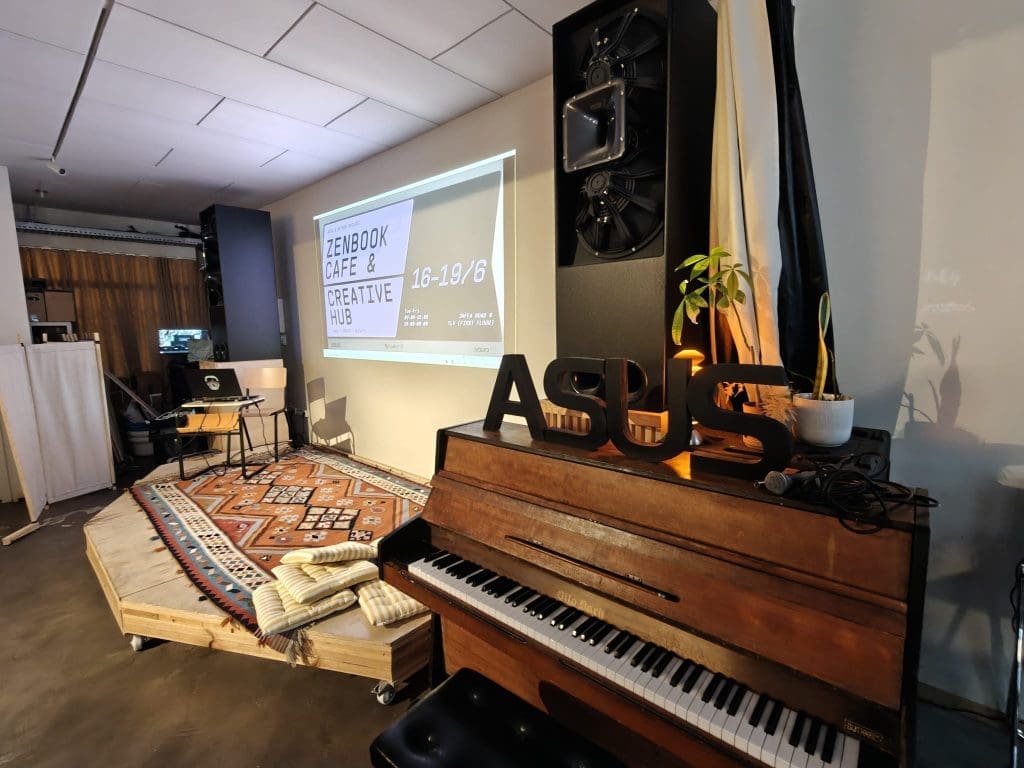
In the heart of Tel Aviv, inside the unique space of the historic Matmon Library at Romano House, ASUS recently launched the Zenbook Cafe & Creative Hub, a four-day pop-up experience designed to bring together technology, creativity, design, and innovative thinking.
More than just a product showcase, the event transformed the library into a collaborative workspace and creative center, featuring expert talks, industry discussions, artistic exhibitions, and hands-on experiences with ASUS’s latest devices. The opening event, held last Wednesday, attracted creators, technology professionals, students, designers, and gaming enthusiasts eager to explore the growing relationship between advanced technology and modern digital creativity.
A Library Reimagined as a Creative Technology Hub
From the moment visitors entered the venue, it was clear that this was not a conventional product launch.
Located at Jaffa Road 9 in Romano House, Matmon Library retained its distinctive character as a public cultural space while embracing a new layer of technology, digital art, and creative expression.
Throughout the venue, visitors could explore ASUS’s latest Zenbook devices, test their displays and performance, and gain insight into how modern laptops have evolved into essential tools for creators, designers, developers, video editors, and content professionals.
Alongside the hardware demonstrations, original artworks inspired by the Zenbook series were displayed throughout the space. The combination of technology and artistic interpretation created a unique atmosphere where laptops were presented not simply as products, but as instruments of creativity capable of transforming ideas into reality.
The decision to host the event inside a library reinforced one of the event’s core messages: the connection between traditional knowledge and technological innovation.
Exploring Video Games as an Artistic Medium
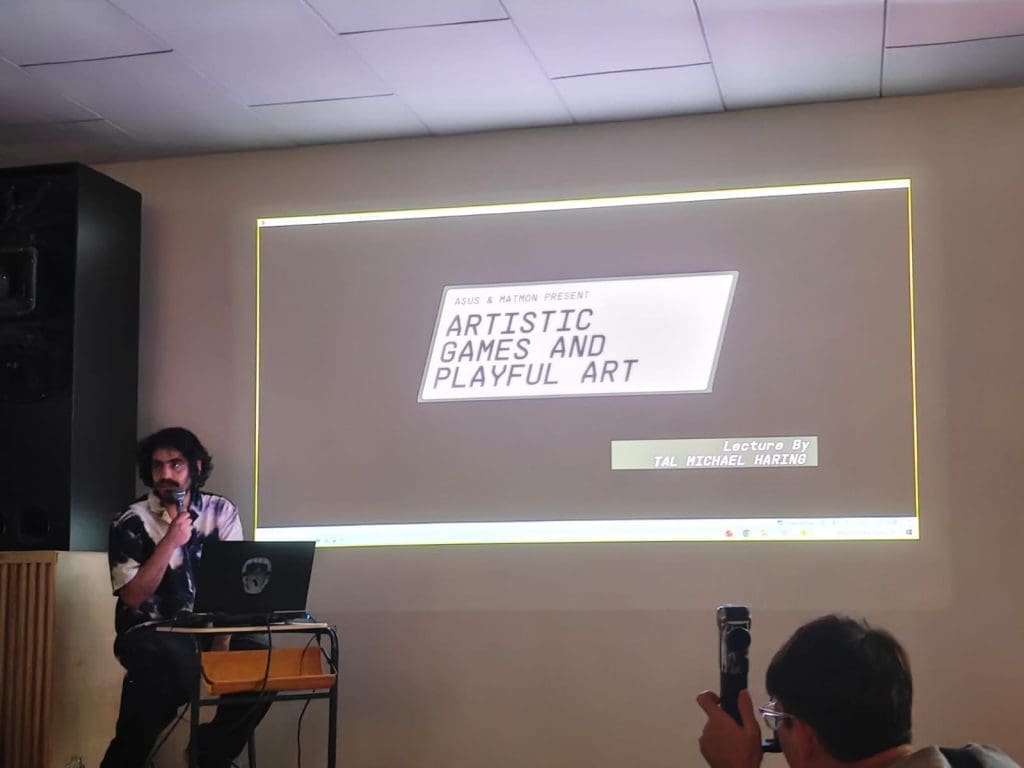
The evening’s keynote presentation was led by Tal Michael Haring, who explored the topic of “Art Games and Game Art”, a subject that has become increasingly prominent in discussions surrounding digital culture and interactive media.
Haring opened by addressing the cultural status of video games. While fields such as film, theater, dance, and visual arts often receive institutional recognition, public funding, and dedicated cultural support, the video game industry in Israel still struggles to achieve similar recognition.
This contrast becomes even more apparent when compared to countries where video games are widely acknowledged as an integral part of modern culture. Despite being one of the world’s largest entertainment industries and influencing billions of people globally, games are still often overlooked as a legitimate artistic and cultural medium.
This lack of support can be particularly challenging for independent developers seeking to create experimental, personal, or artistic projects that prioritize creative expression over commercial success.
How Other Countries Support Artistic Game Development
To illustrate how games are supported internationally, Haring highlighted several funding initiatives dedicated to interactive media and independent game development.
Among the examples discussed was Canada’s Media Fund, which provides support for digital and interactive projects, enabling creators to develop innovative ideas that may not fit traditional commercial models.
Similar initiatives exist across multiple countries, recognizing that games can serve as platforms for storytelling, social commentary, cultural expression, and the exploration of complex human experiences.
Public support not only encourages innovation but also enables a broader diversity of creative voices to emerge within the medium.
What Makes a Game Artistic?
One of the central questions raised during the presentation was deceptively simple: What defines an artistic game?
Unlike many commercial titles that focus on competition, progression systems, and mechanical mastery, artistic games often prioritize emotional, philosophical, or reflective experiences.
Examples presented included experimental projects such as Pigeon: A Love Story and Plane 2 Plane Simple, games that use interactivity as a tool for expressing ideas and emotions rather than simply providing challenges to overcome.
These experiences often invite players to slow down, observe, reflect, and engage with themes that extend beyond traditional gameplay objectives. In these cases, the experience itself becomes the destination rather than victory or achievement.
Season: A Letter to the Future and the Power of Emotional Storytelling
One of the most compelling examples discussed was Season: A Letter to the Future.
Rather than relying on combat, action sequences, or complex progression systems, the game focuses on exploration, observation, and documenting a world on the verge of change.
As players travel through the environment, interact with characters, and record meaningful moments, they gradually develop a deeper emotional connection to the game’s world and its stories.
The title demonstrates how pacing, atmosphere, and environmental storytelling can create powerful emotional experiences without relying on traditional gameplay conventions.
Can Games Be a Space for Reflection?
The discussion eventually expanded into broader questions about the role of art itself.
Art, regardless of its form, provides a framework for processing emotions, exploring personal experiences, and examining complex questions about identity, society, and the human condition.
When video games successfully fulfill these same functions, they move beyond entertainment and become meaningful forms of artistic expression.
This naturally led to another recurring debate within the industry: must games always revolve around challenge and competition, or is there room for slower, more contemplative experiences?
Artistic games often embrace a more deliberate pace, allowing players to engage with ideas, interpret experiences, and form personal connections with the worlds they inhabit.
While some critics argue that such experiences drift away from traditional definitions of gaming, others view them as evidence of the medium’s evolution and growing maturity.
Gameplay Versus Narrative: An Ongoing Industry Debate
Another fascinating topic explored during the lecture was the long-standing tension between gameplay and storytelling.
Critics sometimes argue that artistic games rely too heavily on narrative, dialogue, and cinematic presentation while offering limited traditional gameplay mechanics.
Supporters, however, contend that interactivity itself is what makes these stories uniquely powerful. Rather than observing events from a distance, players actively participate in the experience, make decisions, and engage with narratives on a personal level.
The debate has persisted for years, but it also highlights the diversity and creative flexibility that make games such a unique medium.
Virtual Reality as a New Artistic Frontier
The final section of the presentation focused on virtual reality and its potential as a platform for immersive artistic experiences.
Unlike traditional media, VR places users directly inside an experience, creating a heightened sense of presence and emotional engagement.
This capability has enabled creators to tell deeply personal stories, explore medical and social issues, and generate empathy through direct participation rather than passive observation.
Spot of Light: Experiencing Vision Loss Through VR
One of the featured projects was Spot of Light, a documentary VR experience that tells the story of a soldier who lost his sight during combat in Lebanon.
Through virtual reality, participants do not simply hear about the experience. Instead, they are immersed in a representation of the challenges and emotional realities associated with losing one’s vision.
The project serves as a powerful example of how technology can foster empathy and help audiences better understand complex human experiences.
A Long Goodbye and Living with Dementia
Another project highlighted during the presentation was A Long Goodbye, a VR experience centered on the life of a woman living with dementia.
Through environmental changes, visual distortions, and shifting perspectives, the experience attempts to communicate the confusion, memory loss, and uncertainty often associated with the condition.
By allowing participants to experience these challenges firsthand, VR becomes both an educational and artistic medium capable of conveying realities that are often difficult to explain through traditional storytelling.
Final Thoughts
The launch of the Zenbook Cafe & Creative Hub demonstrated far more than ASUS’s latest hardware innovations.
By combining technology showcases, artistic exhibitions, collaborative workspaces, and thoughtful discussions about the cultural significance of video games, the event created a space where creativity and technology could genuinely intersect.
Tal Michael Haring’s presentation reinforced a growing reality within modern culture: video games are no longer merely entertainment products. They have evolved into platforms for storytelling, emotional exploration, artistic expression, and the communication of deeply human experiences.
For an event centered around technology, the evening’s most memorable takeaway may have been that the most powerful innovations are often those that help people create, connect, and tell meaningful stories.