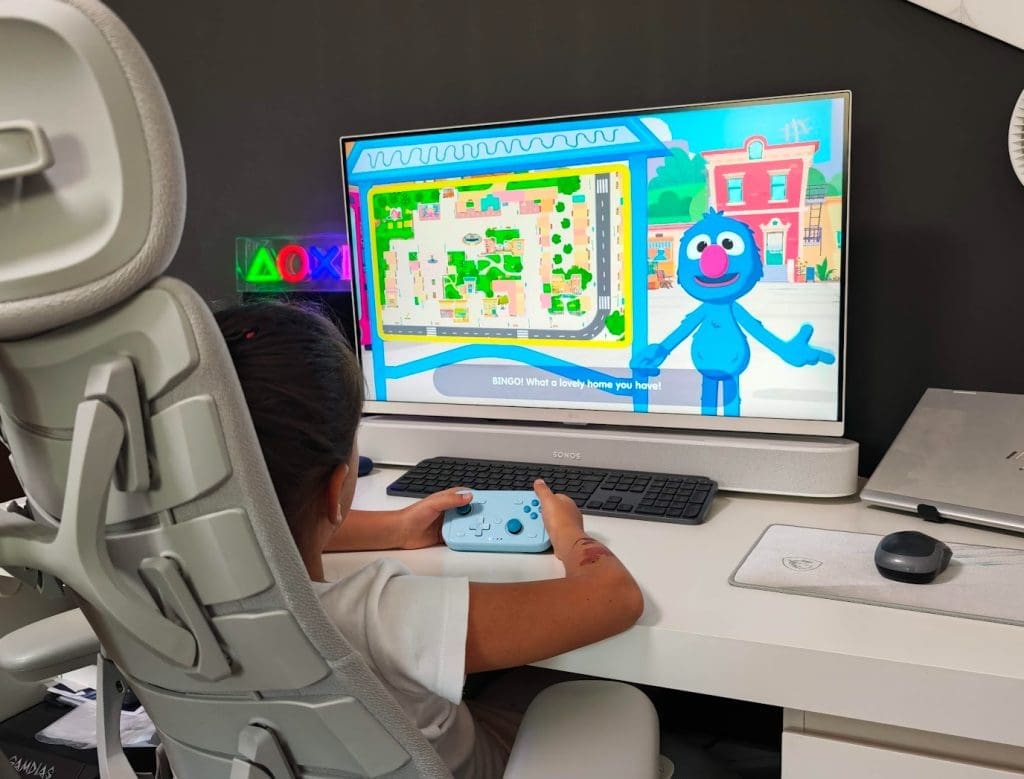
Sesame Street: Friends & Fun is a colourful family adventure that brings Elmo, Cookie Monster, Abby Cadabby, Big Bird and other beloved characters into an interactive world filled with mini-games, exploration, creativity and educational activities. Developed and published by Outright Games in collaboration with Sesame Workshop, the game launched on October 9, 2026, for Nintendo Switch, PlayStation 4, PlayStation 5, Xbox Series X|S and PC. After spending the entire weekend playing it with my family and young children.
I found Sesame Street: Friends & Fun to be an exceptionally accessible and entertaining experience for little players. Both my three-year-old and six-year-old children were able to enjoy the adventure, complete challenges independently and play together without constantly needing an adult to intervene. The game also includes thoughtful cooperative mechanics that make shared play considerably easier for younger children, while its beautiful graphics, educational activities and relatively large world provide plenty of reasons to keep exploring. If you are looking for a family-friendly game that allows children of different ages to play together, Sesame Street: Friends & Fun deserves a place on your shortlist.
A Long-Awaited Return to Sesame Street Gaming
Sesame Street: Friends & Fun marks Sesame Street’s first major console game in 15 years, bringing the franchise back to a format that combines interactive entertainment with the educational principles that have defined its television programming for generations. Rather than focusing on complicated combat, demanding platforming or traditional video game progression systems, the experience is built around exploration, cooperation, creative expression and completing approachable activities throughout a familiar neighbourhood.
The collaboration between Outright Games and Sesame Workshop is central to the game’s identity. Sesame Workshop has spent more than five decades developing educational entertainment for young children, using memorable characters, humour and carefully designed learning experiences to help children develop important life skills. Outright Games, meanwhile, has established a portfolio of family-oriented games based on popular entertainment properties, including Peppa Pig, PAW Patrol, DC’s Justice League and DreamWorks Dragons. Sesame Street: Friends & Fun brings these complementary strengths together in an adventure designed specifically for young players and their families.
The result is a game that understands its audience. Younger children do not necessarily need complicated progression systems or lengthy explanations to remain interested. They need a world that responds to their actions, familiar characters they enjoy spending time with, and activities that offer immediate feedback. Sesame Street: Friends & Fun delivers these elements through a collection of short challenges and an inviting environment that encourages children to experiment and explore at their own pace.
Playing Together With Children of Different Ages
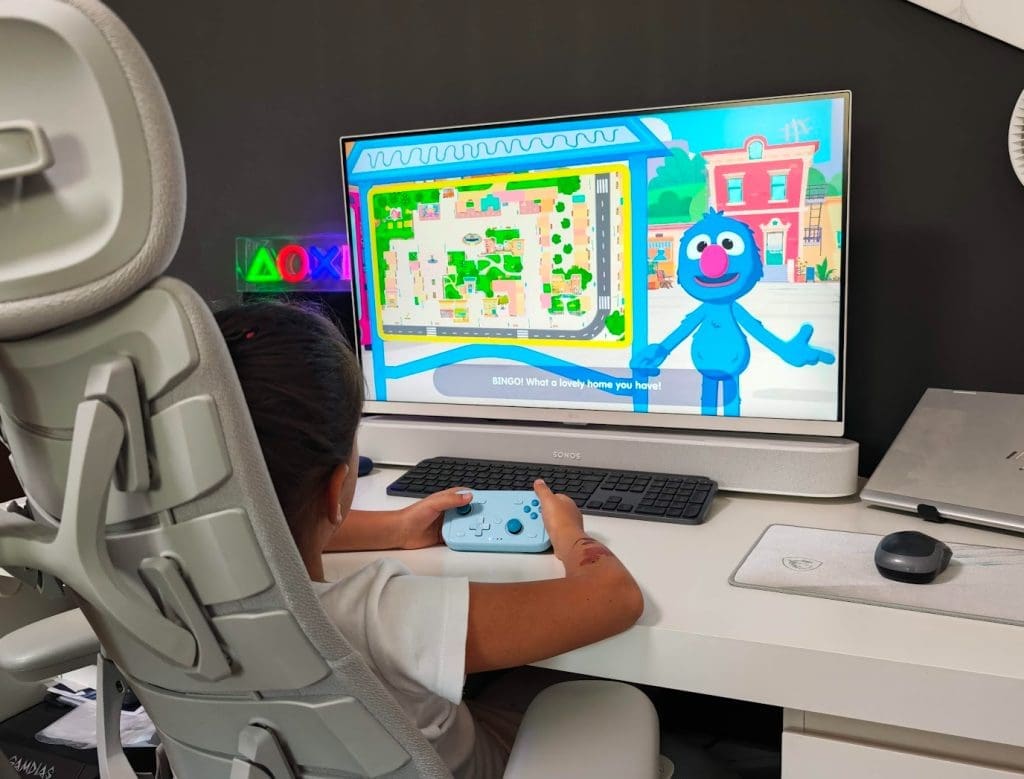
One of the most impressive aspects of Sesame Street: Friends & Fun is how well it accommodates children with different levels of gaming experience. I spent the weekend playing with my family, including children aged three and six, and both were able to participate meaningfully. Neither child needed to understand complicated mechanics or master precise controls before enjoying the experience, and they were able to tackle the majority of the challenges themselves.
This is particularly important for parents looking for games that siblings can enjoy together. A game designed for a six-year-old can easily become frustrating for a three-year-old, especially when it requires precise movement, complex menus or fast reactions. Conversely, an experience designed exclusively around very basic interactions may quickly lose the interest of an older child. Sesame Street: Friends & Fun finds a comfortable middle ground by combining straightforward controls with a wide variety of activities, allowing both children to discover things they enjoy.
The difference between the two age groups was noticeable in the way they approached the world, but that did not prevent them from playing together. They could explore the map, discover new activities and participate in challenges without the older child needing to complete everything on behalf of the younger one. The game creates opportunities for shared discovery rather than making cooperation dependent on one player carrying the other.
For families, this accessibility can make a substantial difference. The game does not simply place two characters on screen and expect children to figure everything out. Its overall design helps younger players remain involved, reducing the frustration that can arise when one child becomes separated from the action or struggles to understand what to do next.
Two-Player Local Cooperative Play That Actually Works
Sesame Street: Friends & Fun supports two-player local cooperative play, allowing two people to explore and participate in the adventure together on the same system. This is one of its most valuable features because it turns the game into a shared family activity rather than an experience that children have to take turns playing.
What particularly impressed me was the way the game handles players who struggle to stay within the playable area. When the second player wanders too far away from the action, the game brings them back into the screen. This is a simple but extremely effective cooperative mechanic, especially when playing with very young children who may not fully understand the boundaries of a shared camera or the need to remain close to another character.
In many cooperative games, younger players can accidentally move in the wrong direction, become separated from their partner or spend time trying to find their way back to the action. Such situations can quickly interrupt the fun, particularly when one player is still learning the basics of controlling a character. By automatically bringing the second player back when they move outside the permitted area, Sesame Street: Friends & Fun removes much of this unnecessary friction.
During our family sessions, this mechanic helped keep both children involved. They could focus on the activities themselves instead of worrying about camera boundaries or navigation rules. The game effectively takes responsibility for part of the coordination that would otherwise fall on the players, making cooperative play much more manageable for children who are still developing their spatial awareness and controller skills.
The importance of this design should not be underestimated. Local cooperative play is often advertised as a family feature, but the quality of the implementation determines whether it is genuinely suitable for young children. In this case, the automatic repositioning system demonstrates a clear understanding of the challenges involved in introducing preschoolers to cooperative video games.
Exploring a Colourful World Inspired by Sesame Street
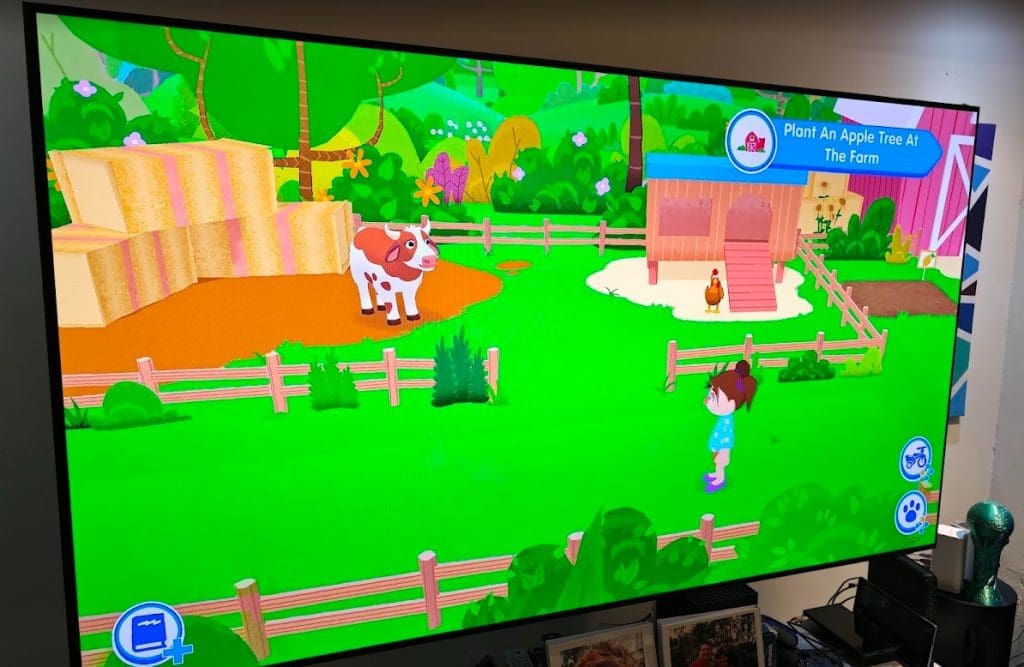
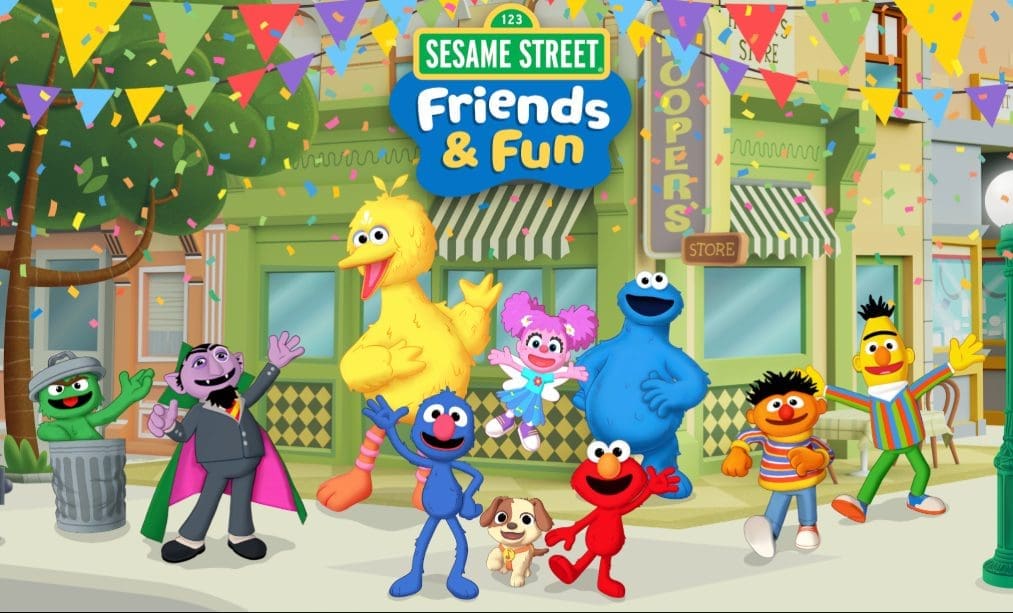
The game offers three colourful locations inspired by the Sesame Street universe, providing a range of environments for children to explore. The wider Sesame neighbourhood includes areas such as the Community Garden, Bandstand and Farm, while the sunny Park and attraction-filled Fun Fair introduce additional spaces filled with activities and interactive elements.
Rather than restricting the experience to a sequence of individual mini-games, the game places these activities within a larger world. Children can move between locations, investigate their surroundings and discover things that catch their attention. This creates a more natural sense of exploration, allowing them to decide where to go instead of following a rigid sequence of objectives.
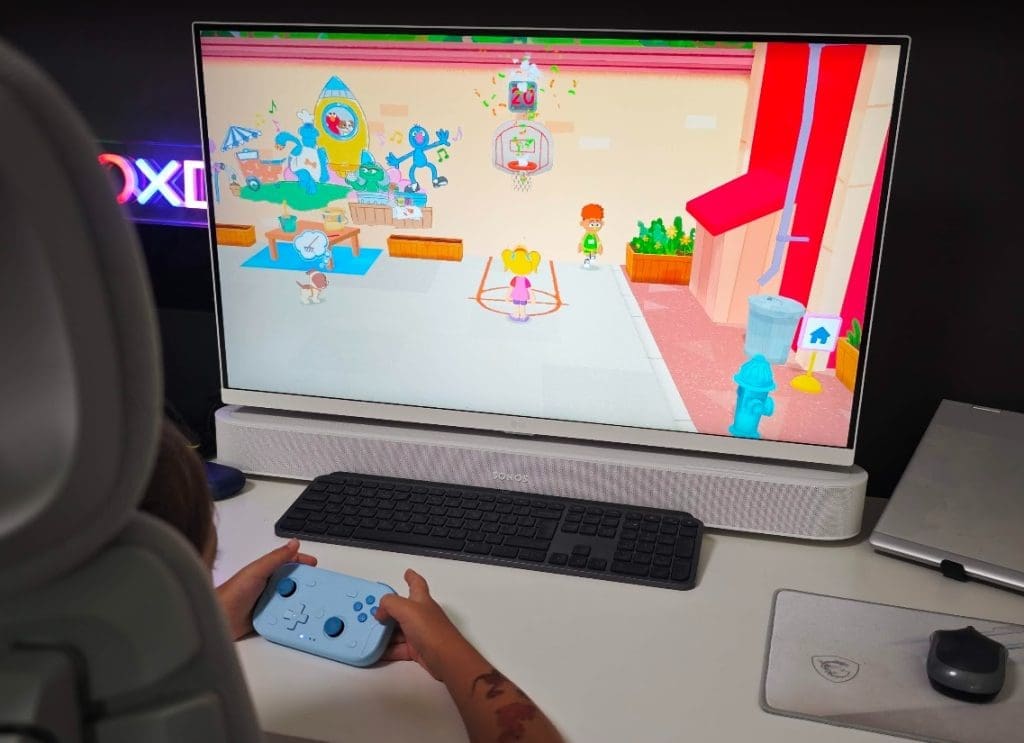
The relatively large map was a highlight during our play sessions. My children enjoyed moving around the environment and discovering activities on their own, often finding something interesting without needing me to explain where to go. The world provides enough variety to make exploration feel rewarding, while its familiar visual language helps younger players understand that different areas contain different things to do.
The environments also give the game a sense of place. The Community Garden, Farm, Park and Fun Fair are not simply interchangeable backgrounds. Each offers a different atmosphere and opportunities for interaction, helping the world feel like a neighbourhood preparing for an important community celebration.
For young children, this style of exploration can be particularly appealing. They can spend time on a specific activity, wander off to investigate something else and return to a previous location when they feel like it. The experience accommodates curiosity rather than demanding constant forward progress, making it suitable for shorter play sessions as well as longer family gaming afternoons.
Finding Activities Without Constant Adult Assistance
A major strength of Sesame Street: Friends & Fun is how it helps children navigate its world when they are unsure where to go. During our sessions, my children discovered educational activities scattered throughout the map, often simply by wandering around and following their curiosity.
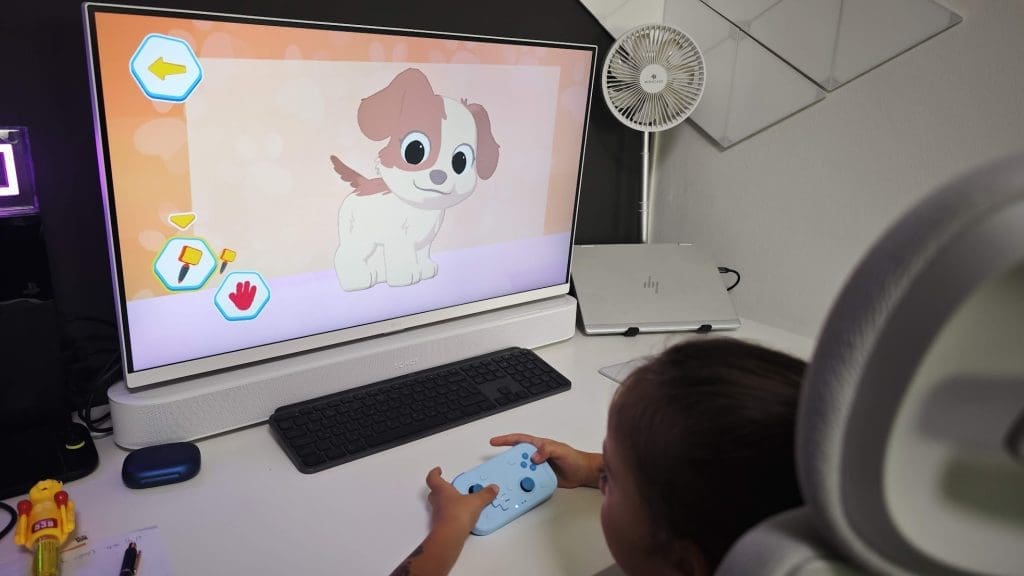
When they became lost or were unsure how to reach the next destination, they could follow the dog or look for markings on the ground. These visual and environmental clues provided a straightforward way to get back on track without requiring an adult to explain every step. For children who cannot yet comfortably read instructions, visual guidance is especially useful because it communicates what to do without relying on text-heavy menus or complicated quest descriptions.
This approach also allows children to develop confidence in navigating a game independently. Instead of immediately asking a parent for help, they can look around, identify a clue and follow it toward the next activity. Even when they do not fully understand the underlying objective, the environment provides enough direction to encourage them to keep trying.
The result is a more relaxed experience for parents and children alike. Adults can participate in the adventure without needing to function as a permanent guide, while children retain the freedom to explore at their own pace. This balance between independence and assistance is particularly valuable when a game is intended for preschool-aged players.
More Than 100 Mini-Games and Educational Activities
Sesame Street: Friends & Fun features more than 100 mini-games and activities, giving the adventure considerable variety. These activities cover a broad range of interactions, including shape tracing, counting, sorting, problem-solving, creative challenges and other playful tasks designed to encourage early learning.
The number of activities is important because young children often move rapidly between interests. A mini-game that captures their attention for several minutes may be followed by a desire to explore something completely different. By providing a large selection of activities across the world, the game gives children opportunities to experiment with different types of challenges instead of repeating the same interaction throughout the entire experience.
Educational activities are also integrated into the wider adventure. Rather than presenting every learning exercise as a separate classroom-style lesson, the game places challenges within an environment where children are already motivated to explore. This can make counting, sorting and recognising shapes feel like part of the adventure instead of a formal exercise.
The variety also helps accommodate different developmental stages. Some activities are approachable enough for very young players, while others require a little more attention, coordination or problem-solving. Children can encounter these challenges naturally and develop familiarity with their mechanics through repeated play.
During our weekend sessions, my children managed to complete the challenges independently in most cases. They enjoyed discovering new activities and trying them without needing me to explain the solution. This is an encouraging sign for a game intended to combine entertainment with early learning, since children remain engaged while exercising their ability to understand instructions, recognise patterns and experiment with different actions.
Educational Value Without Losing the Fun
Educational gaming works best for young children when learning is connected to an activity they genuinely want to complete. Sesame Street: Friends & Fun follows this principle by using interactive challenges to encourage skills such as counting, sorting, shape recognition and basic problem-solving.
These activities can support the development of early mathematical concepts and visual recognition. Counting exercises encourage children to associate numbers with quantities, while sorting challenges introduce the idea of grouping objects according to shared characteristics. Shape-based tasks can help develop visual discrimination and familiarity with basic geometric forms.
The interactive format also gives children an opportunity to learn through trial and error. They can attempt a challenge, observe the result and adjust their actions. This kind of feedback can help maintain interest because children can immediately see how their decisions affect what happens on screen.
The educational component is complemented by the game’s wider emphasis on kindness, friendship and helping the community. Preparing for the Big Block Party gives the adventure a shared objective, while interactions with familiar characters create opportunities to help others and participate in activities around the neighbourhood.
It is important to distinguish between educational design and a guarantee of measurable learning outcomes. Playing a game does not automatically mean a child will master a particular skill. However, the combination of approachable challenges, repetition, visual feedback and playful exploration gives families a useful way to introduce educational concepts within an entertaining activity.
The One Mini-Game That Gave Us Trouble
Although the majority of the activities were accessible to my children, one particular type of challenge proved more difficult. The shape-tracing activity required drawing shapes using the Nintendo Switch Joy-Con controllers, and this interaction was less comfortable for the children than the other mini-games.
The problem was not necessarily the concept of recognising or drawing shapes. Rather, translating a child’s hand movements into sufficiently accurate controller input can be challenging, especially when the activity expects a degree of precision that a very young player may not yet possess. Children aged three and six can have very different levels of fine motor control, and even an otherwise simple task can become frustrating when the controls do not respond in the way they expect.
This stood out because most of the rest of the game was so easy for them to understand. They could complete other challenges without much assistance, but the shape-drawing interaction required more effort. It was a useful reminder that accessible game design involves more than simplifying the objective. The physical interaction required to complete a task matters just as much.
Nevertheless, this was a relatively isolated issue during our sessions rather than a problem that defined the overall experience. The children continued to enjoy the broader adventure, and the large selection of other activities meant there were plenty of alternatives to explore. Families whose children struggle with precise controller movements may need to provide a little assistance with this particular activity, but it did not prevent my children from enjoying the game together.
Nintendo Switch Controls and Family-Friendly Accessibility
The Nintendo Switch version is particularly appealing for families who want to play together in the living room. Its local cooperative functionality makes it possible for two players to share the adventure on one system, while the Joy-Con controllers provide a familiar and accessible entry point for children who are new to gaming.
However, controller accessibility should not be confused with identical ease across every activity. Basic movement and interaction were approachable for my children, but the shape-tracing challenge demonstrated that motion-oriented or precision-based tasks can present additional difficulties. This is a relevant consideration for parents choosing a first video game for a preschooler.
The game’s broader design helps compensate for these occasional difficulties. Children are encouraged to explore, interact with characters and try different activities, rather than being required to master a single demanding mechanic before they can continue. The automatic repositioning of the second player also reduces the complexity of navigating the world cooperatively.
Sesame Street: Friends & Fun is available on Nintendo Switch, PlayStation 4, PlayStation 5, Xbox Series X|S and PC. The shared family-oriented concept extends across these platforms, although the specific controller experience will naturally depend on the hardware being used.
For families already using a Nintendo Switch as their primary gaming system, the combination of local multiplayer and approachable gameplay makes this a particularly relevant option. Parents should still consider the age and coordination of their children, but the overall experience is designed to lower the barriers that often make traditional video games difficult for very young players.
Create a Character and Make the World Your Own
Beyond exploration and mini-games, Sesame Street: Friends & Fun offers customisation options that let children create their own place within the Sesame Street universe. Players can design a fully customisable character and select clothing and other visual elements to reflect their preferences.
Character customisation can be a meaningful feature for young players because it gives them a sense of ownership over the adventure. Instead of controlling an entirely predetermined character throughout the experience, children can create an avatar that represents them in the world. Choosing how that character looks becomes another form of creative play.
The customisation extends beyond the player character. Children can also design their own home and decorate parts of the neighbourhood using a selection of clothing, furniture and decorative items. These features add another dimension to the game, allowing children to move between structured challenges and activities that are more focused on personal expression.
Home decoration also introduces a different kind of engagement from the game’s educational mini-games. Rather than completing a task with a clearly defined answer, children can make choices according to their own tastes. They can experiment with different combinations, change their surroundings and create a space that feels personal.
For families, these systems provide additional opportunities for children to express their creativity and share their choices with a sibling or parent. The adventure is not limited to completing activities and preparing for the party; it also encourages children to spend time shaping the world they inhabit.
Elmo, Cookie Monster and a Familiar Cast of Characters
The character roster is another important part of the experience. Elmo, Abby Cadabby, Tango, Grover, Cookie Monster, Ernie, Bert, The Count, Oscar the Grouch and Big Bird all appear to help players as they prepare for the Big Block Party.
These characters provide a familiar point of connection for children who already know Sesame Street from television, books or other forms of entertainment. Recognising a favourite character can make a new game feel welcoming from the beginning, particularly for players who are still learning what video games are and how they work.
The activities associated with the characters help reinforce the sense that the neighbourhood is a living community. Players can cook with Cookie Monster, help Abby with magic, care for Tango and deal with mischievous chickens, among other tasks. These varied interactions provide context for the mini-games and give children reasons to visit different areas of the world.
The familiar cast also supports the game’s emphasis on friendship and helping others. Rather than presenting the player with an abstract list of objectives, the adventure places activities within the context of a neighbourhood populated by recognisable personalities. The characters provide a reason to explore, while their requests help connect individual challenges to the larger goal of preparing for the celebration.
For younger players, this combination of recognition and interaction can be particularly effective. The characters are not merely decorative additions to the environment; they are part of the experience that gives the world its identity.
Preparing for the Big Block Party
The central objective of Sesame Street: Friends & Fun is to help prepare for the biggest celebration of the year, the Big Block Party. Players become guests of honour after creating their own characters and contribute to the festivities by helping residents throughout the neighbourhood.
This structure provides a simple narrative framework for the many activities available across the game. The individual challenges may involve very different actions, but they all contribute to the broader idea of helping the community get ready for a shared event.
For young children, a straightforward objective can be more useful than a complicated story involving numerous characters, lengthy dialogue or elaborate progression systems. Preparing for a party is an easily understood goal, and the activities along the way give players a reason to explore without requiring them to remember a complex series of narrative developments.
The celebration also fits naturally with Sesame Street’s emphasis on kindness, friendship and cooperation. The player succeeds by helping others and participating in community activities, reinforcing the idea that working together can be rewarding.
This approach gives the adventure a clear sense of purpose while leaving plenty of room for free exploration. Children can focus on the next task, wander off to discover a new mini-game or spend time customising their character and home. The central celebration connects these different activities without forcing every play session to follow the same rigid sequence.
Graphics, Animation and Visual Presentation
Visually, Sesame Street: Friends & Fun is a very attractive game. The colourful environments, familiar character designs and playful presentation help create a world that feels appropriate for its young audience. During our family sessions, the graphics were one of the aspects that immediately stood out to me.
A game aimed at preschoolers benefits from visual clarity as much as it benefits from attractive artwork. Children need to distinguish characters, identify objects and understand where they can interact with the environment. Bright colours and recognisable shapes can help make these elements easier to understand, while different locations provide visual variety that encourages further exploration.
The game’s presentation also supports its friendly atmosphere. Rather than relying on intense visual effects, threatening enemies or dark environments, it offers a welcoming world centred on activities, characters and discovery. This makes it easier for parents to introduce the game to children who may not yet be comfortable with more demanding or intense gaming experiences.
The environments complement the mini-game structure by giving children places to explore between activities. Moving through the neighbourhood, visiting the Farm or discovering the Fun Fair feels like part of a larger adventure rather than simply selecting another item from a menu.
Although the visual appeal alone does not determine whether a family game succeeds, it is an important part of the experience. In this case, the graphics help maintain the game’s inviting personality and make exploring the world enjoyable even when children are not actively completing a challenge.
A Game Designed Around the Needs of Young Players
Many games marketed to families are still primarily designed around traditional gaming conventions. They may feature simple characters and colourful environments but continue to rely on precision platforming, demanding timing or complicated navigation. Sesame Street: Friends & Fun takes a more accommodating approach.
The game’s combination of straightforward controls, environmental guidance, local cooperative play and a wide selection of activities reflects an understanding of the difficulties young children can face. They may not always follow the intended route, understand every instruction or keep their characters within the camera’s boundaries. A successful game for this audience needs to anticipate these behaviours rather than constantly punish them.
The automatic return mechanic for a separated second player is an especially good example. It recognises that young children often explore without thinking about the other player’s position and provides a solution that preserves the flow of the experience. Similarly, the use of visual clues helps children navigate without requiring them to read detailed instructions.
These systems allow the game to remain accessible without reducing the entire experience to a collection of passive interactions. Children can still move around a relatively large world, discover activities and complete challenges independently. The design simply removes unnecessary obstacles that would otherwise make the adventure less enjoyable.
No game will be equally easy for every child, and individual abilities vary considerably at ages three and six. Our experience nevertheless suggests that Sesame Street: Friends & Fun succeeds at making a substantial amount of its content accessible to children with different levels of gaming experience.
How Much Content Can Families Expect?
With more than 100 mini-games and activities, several distinct locations, character customisation, home decoration and cooperative exploration, Sesame Street: Friends & Fun offers a broad range of things to do. Its content is designed to encourage discovery rather than relying exclusively on a single central activity.
The mini-games provide variety, while the larger world gives children space to move between them. Customisation adds another layer of engagement, and the preparation for the Big Block Party ties the experience together. These different elements help the game appeal to children who enjoy different styles of play.
The actual amount of time a family spends with the game will depend on the children’s ages, interests and willingness to revisit activities. Younger children may happily repeat a favourite mini-game, spend considerable time exploring an area or focus on decorating their home. Older children may be more interested in discovering every location and trying as many challenges as possible.
During our weekend with the game, the children repeatedly wanted to return to the adventure and continued finding activities that interested them. Their enthusiasm was one of the clearest indications that the combination of exploration, familiar characters and short challenges was working for our family.
The large number of activities does not automatically guarantee that every mini-game will appeal equally to every player. Our experience with shape tracing demonstrates that some interactions may be less suitable for children who struggle with precise controls. Nevertheless, the variety gives families plenty of alternatives, making it easier to find activities that match their children’s interests and abilities.
Is Sesame Street: Friends & Fun Worth Playing With Your Family?
For parents looking for a game that allows young children to play together, Sesame Street: Friends & Fun has several important advantages. It supports two-player local cooperative play, provides a colourful world to explore, includes more than 100 mini-games and activities, and offers familiar characters that can help children feel comfortable with the experience.
Its strongest feature is the way these elements work together. The game is not simply a collection of educational exercises, nor is it a conventional adventure with Sesame Street characters added to the surface. It combines exploration, creativity, cooperation and learning in a format that encourages children to participate at their own pace.
My experience with children aged three and six was particularly positive. Both were able to play together, complete most challenges independently and discover activities throughout the map. The automatic repositioning of the second player helped keep them together, while the environmental clues made navigation easier when they became lost.
The main drawback we encountered was the shape-tracing mini-game, which was somewhat difficult to control using the Nintendo Switch Joy-Con controllers. However, this did not overshadow the broader experience. The children enjoyed the graphics, explored the world enthusiastically and continued wanting to play throughout the weekend.
Families should remember that individual children have different coordination skills and gaming preferences, so not every activity will necessarily be equally accessible. Even so, the game’s emphasis on approachable controls, exploration and shared play makes it a strong candidate for households introducing young children to video games.
Conclusion
Sesame Street: Friends & Fun is a charming and highly accessible family adventure that combines colourful graphics, educational mini-games, character customisation and cooperative exploration into an experience designed for young children. Its more than 100 activities, recognisable cast of characters and relatively large world provide plenty of opportunities for discovery, while its thoughtful multiplayer mechanics make it easier for children of different ages to play together. After spending an entire weekend with the game alongside my family, I was particularly impressed by how independently my three-year-old and six-year-old children could complete challenges, navigate the world and enjoy the adventure together. The shape-tracing activity was less comfortable to control with the Nintendo Switch Joy-Con controllers, but this was a minor issue within an otherwise enjoyable experience. Available on Nintendo Switch, PlayStation 4, PlayStation 5, Xbox Series X|S and PC, Sesame Street: Friends & Fun is an excellent option for parents searching for a shared gaming experience that encourages creativity, exploration, early learning and cooperation. If you have been looking for a family game that your little ones can genuinely enjoy together, this is one you should definitely try.