A Story That Made Me Reconsider AI-Driven Games
I went into the OMEA.ai demo with a fair amount of skepticism. The idea of playing a narrative game built so heavily around artificial intelligence immediately raised concerns for me, especially because storytelling is one of those areas where personality, pacing, tension, and consistency matter far more than technological novelty. Still, I wanted to give it a genuine chance, and the demo gradually became much more interesting than I expected. The adventure I played follows a group of Vikings who have been shipwrecked and washed ashore, while I control a protagonist who does not even know his own name. That simple mystery gives the opening an immediate sense of uncertainty, and the plot quickly develops into something surprisingly layered and tense. Instead of feeling like I was simply sending prompts to an AI system, I started becoming curious about the world, the characters around me, and most importantly, what would happen if I deliberately tried something the game had not prepared for.
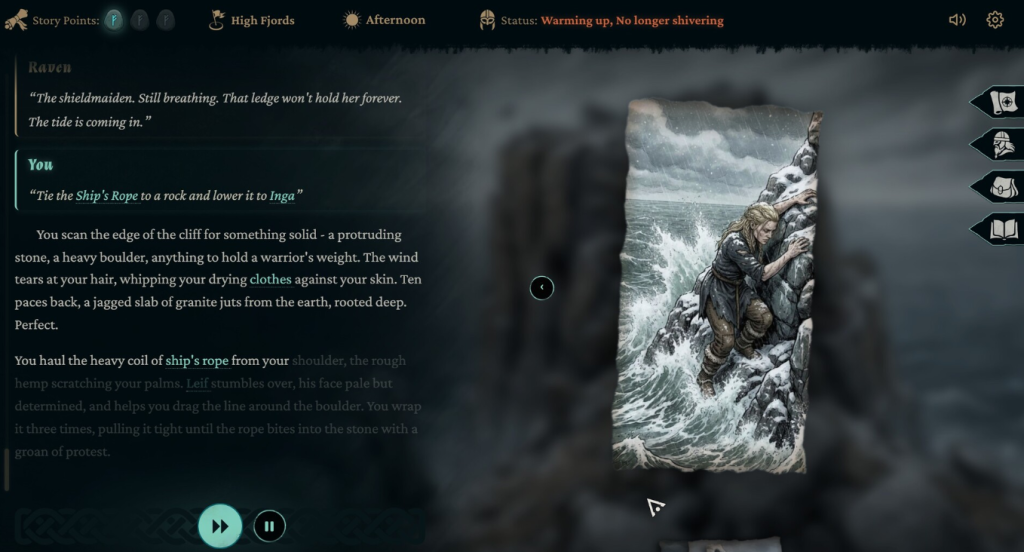
What helps OMEA.ai stand apart is the way player interaction works. After each narrative section, I could type what I wanted my character to do using natural language, with up to 512 characters available for each action. That creates considerably more freedom than a traditional RPG dialogue wheel because I was not limited to deciding which developer written sentence best represented what I actually wanted to do. I could describe an action, question someone, investigate something suspicious, lie, avoid confrontation, or approach a situation from another direction entirely. OMEA also provides two predefined choices for players who do not want to write their own response every time, although this is one area where I think the demo could improve. Two options simply feel too restrictive, particularly in a game built around freedom of choice. Having three or four suggested responses would make the experience more accessible without undermining the free text system that makes OMEA interesting.
The Technology Works Best When You Stop Thinking About the Technology
OMEA is built around what AImmersive describes as its proprietary Narrative Intelligence technology, designed to understand story structure, characters, pacing, relationships, and previous decisions rather than functioning like a conventional chatbot. From a player’s perspective, that distinction is important because the game needs to maintain the illusion that I am interacting with an actual world rather than repeatedly generating disconnected responses. The system is designed to remember previous decisions across an adventure, allowing earlier actions to influence characters and future situations. That kind of persistent memory has enormous potential for narrative RPGs because traditional games inevitably need developers to predict which paths players might take. Here, the promise is almost the opposite: the player can attempt something unexpected and the system tries to integrate that decision into the ongoing story instead of simply refusing to let it happen.
The presentation also deserves more attention than I initially expected to give it. The audio in the OMEA.ai demo is genuinely well produced and adapts nicely to the situations taking place during the adventure. Voice work, sound effects, and music help compensate for the fact that much of the experience revolves around listening, reading, imagining the environment, and deciding what to do next. This matters because without convincing audio, a system like OMEA could very easily feel like an elaborate text generator. Instead, the sound design helps create atmosphere during tense encounters and quieter narrative moments. The developers also disclose that AI is used dynamically for narrative progression and responses, while AI-generated material served as a foundation for some graphics, sounds, and music, with visual material receiving human artist editing. I still think players who are uncomfortable with generative AI should know exactly what they are getting into, but once I stopped focusing on the fact that AI was behind so many elements and started treating OMEA simply as an interactive adventure, I found myself much more engaged.
Who OMEA.ai Is Really For
This is also where expectations become important. OMEA.ai is not an action RPG where something explodes every thirty seconds, and players searching for constant combat will probably lose interest quickly. The entertainment comes from experimentation, exploration, puzzles, conversations, decisions, and seeing how the narrative responds when you push against what would normally be the boundaries of a game. For me, the Viking demo worked because the mystery surrounding the protagonist and the shipwreck gave me reasons to investigate instead of simply waiting for the next fight. The slower pacing also encourages you to think about your response before entering it. Sometimes I wanted to approach the situation logically, while at other moments I deliberately tested whether the game would understand a less obvious action. That curiosity became one of the strongest parts of my experience.
I can therefore see OMEA appealing particularly to players who enjoy storytelling, tabletop RPGs, interactive fiction, puzzle solving, visual novels, and adventure games where imagination is as important as mechanical skill. There is also an interesting creative element because writing your own actions makes you partially responsible for the direction and personality of your version of the protagonist. You can build a character from scratch or use an existing one, and the wider OMEA platform is designed around different worlds and genres created by writers and game designers while the AI reacts to player behavior in real time. Because the narrative engine can potentially respond to a very wide range of actions, the developers also warn that generated situations may occasionally move into content inappropriate for younger players despite censorship systems being implemented, particularly around sexual material. That unpredictability is both one of OMEA’s biggest creative strengths and something the developers will need to keep controlling carefully as the platform expands toward Steam, iOS, and Android.
Conclusion
The OMEA.ai demo did something I honestly did not expect when I started playing it: it made me interested in seeing where this idea goes. I began the experience worried that an AI powered narrative RPG would feel artificial, repetitive, or emotionally empty, but the combination of a surprisingly complex Viking storyline, strong atmospheric audio, natural language interaction, and the ability to test unusual actions gave the demo its own identity. I still want more predefined choices than the current two, and I think the concept will naturally appeal much more to patient players who enjoy stories and puzzles than people looking for nonstop action. But as someone who was initially hesitant to even give a game built so heavily around AI a chance, I came away wanting to keep experimenting with it. OMEA is most interesting when you stop asking whether the AI can generate another response and start wondering whether the world will actually remember what you just did.