I was given the opportunity to see Hasbro Games Junior Collection and its Monopoly Junior experience during a meeting at Gamescom, where I had the chance to get a much closer look at how the game translates one of the world’s most recognizable family board games into a digital format. What immediately stood out to me was just how deliberately the experience has been adapted for younger players. Rather than simply taking the traditional Monopoly formula and putting it on a screen, the game appears to rethink the way younger children interact with the mechanics, presentation and pacing of the experience. At the same time, it retains enough of the recognizable Monopoly structure to make it feel authentic. I was particularly impressed by the balance between accessibility and genuine gameplay depth, with mechanics designed for younger players without introducing the complexity that can sometimes make strategy-heavy board games difficult for children. The colorful presentation, interactive dice mechanics, character customization, familiar locations and competitive mini-games all contribute to an experience that feels designed around family play rather than simply being a simplified version of a more advanced game. After seeing it in action, I came away very positively impressed, and I am already looking forward to trying the game with my own family when it launches.
From a Generational Board Game to a Digital Family Experience
Monopoly has been part of family entertainment for generations. Since its introduction in 1935, the franchise has evolved into one of the most recognizable tabletop gaming brands in the world, with its basic concept remaining remarkably consistent: players move around a board, acquire properties, collect money, make strategic decisions and attempt to avoid financial setbacks. Its appeal comes partly from that simplicity, but also from the way a relatively small number of rules can create very different experiences from one game to another.
That formula became particularly important for younger players with the introduction of Monopoly Junior in 1990. The Junior version was designed specifically to make the basic Monopoly experience easier to understand and more approachable for children, introducing many players to tabletop gaming through a recognizable combination of movement, property collection and simple financial decisions. The new digital implementation builds on that foundation, but it is not limited to simply reproducing a physical board on a television or monitor.
A Game Designed Around Younger Players
During my Gamescom presentation, one of the most interesting aspects was seeing how carefully the experience has been structured around children. The design does not appear to assume that a young player already understands traditional Monopoly strategy, complex economic systems or long-term resource management. Instead, the mechanics are presented through highly visual interactions, recognizable destinations, colorful environments and short gameplay actions that are easier to understand.
This is particularly important for a family game because the youngest player can easily become overwhelmed when too many systems are introduced simultaneously. Monopoly Junior takes a different approach. The core decisions remain understandable: move around the board, acquire locations, collect money and react to opportunities. Yet the digital format allows the developers to introduce additional interactivity without turning those systems into complicated menus or demanding layers of information.
Simple Rules With Meaningful Strategy
Although the experience is aimed at younger players, simplicity does not mean that every decision is completely random. Strategy remains an important part of Monopoly Junior. Players are encouraged to collect properties and generate income when opponents land on locations they control, while chance-based mechanics can dramatically change the situation during a match.
This creates an interesting balance between predictable progression and unexpected events. A player can work toward building an economic advantage through property collection, while another can potentially rely more heavily on dice outcomes and cards. The result is a game where children can begin understanding concepts such as risk, reward, ownership, competition and resource management without having to deal with the much more complicated economic calculations associated with traditional Monopoly.
Different Player Personalities
One of the more entertaining concepts presented for the game is the idea that different players can naturally develop different playing styles. Some players may become the equivalent of a Cash Collector, concentrating on acquiring properties and building a reliable source of income. Others may become more aggressive or unpredictable players who rely on opportunities presented by cards and dice rolls.
The Lucky Challenger approach, for example, emphasizes unpredictability. Instead of simply following a conservative strategy, this type of player can use chance-based mechanics to try to change the course of the game. For younger players, this creates an accessible introduction to the idea that different strategies can produce different results, while the relatively straightforward rules prevent the experience from becoming intimidating.
The Digital Dice Changes Everything
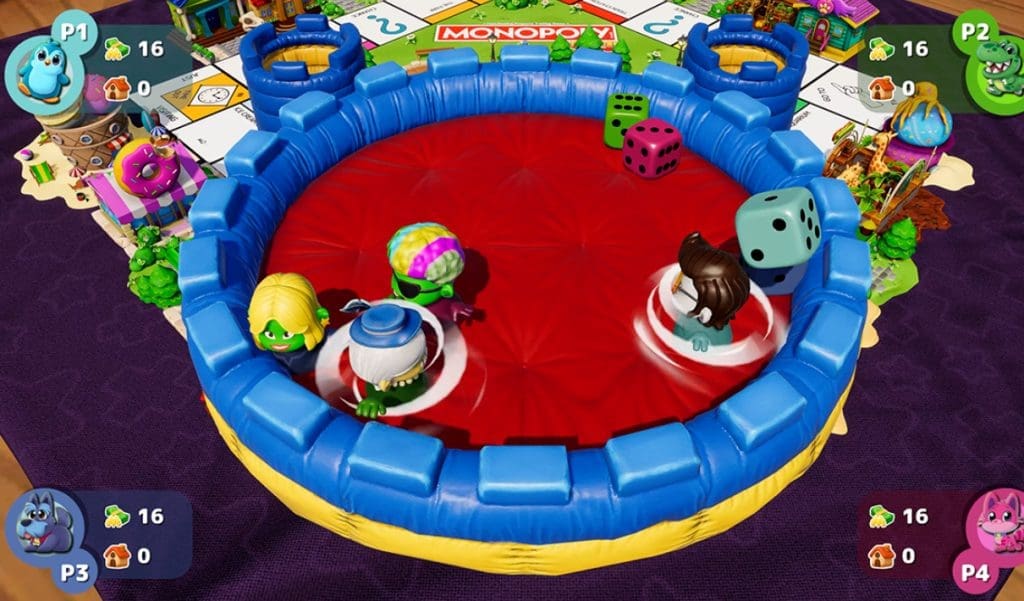
One of the most distinctive elements of the digital version is the way players interact with the dice. Unlike physical Monopoly Junior, where the dice are simply rolled onto the table, the digital implementation turns rolling the dice into an interactive gameplay event.
Players can manipulate the dice as it is thrown, including spinning it into the air, pushing it away from other players and jumping to attempt another toss. This transforms what would normally be a single button press or simple animation into a small gameplay sequence of its own.
Every Dice Roll Becomes a Mini-Game
The approach is particularly interesting because every player participates in the dice toss. Instead of one player simply pressing a button while everyone else waits, the other players become involved in the action. The result is a more energetic multiplayer experience that reinforces the idea that Monopoly Junior is intended to be played together.
The timer adds another layer to this mechanic. Players have a limited period in which to interact with the dice, and once the timer expires, the result determines how far the active player’s character moves across the board. This gives even the movement phase a more dynamic quality and helps maintain engagement between turns.
A Living 3D Monopoly Board
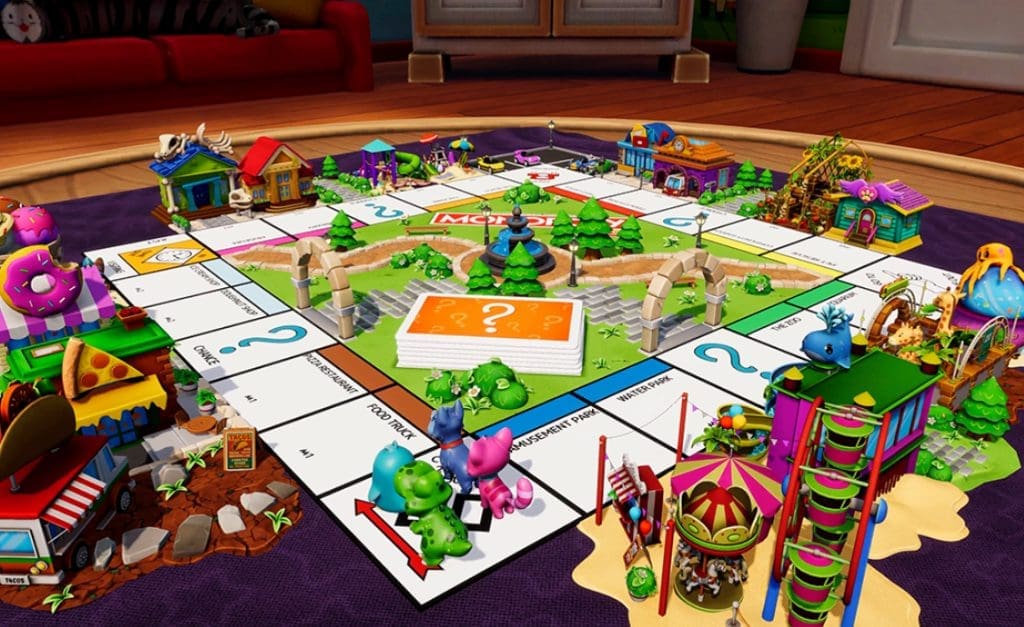
After the dice determines the movement, the player’s avatar travels across a three-dimensional representation of the Monopoly Junior board. Rather than presenting the board as a static collection of spaces, the digital version uses the additional capabilities of a modern game engine to create a more visually active environment.
Players can land on and collect recognizable locations such as the library, beach, veterinarian and zoo. As properties are acquired, the board progressively becomes more colorful and visually developed. This gives property collection a direct visual representation, making progression easier for younger players to understand.
Visual Feedback Makes Progress Easier to Understand
This visual approach is particularly useful for children who may not immediately understand numerical indicators or traditional board-game accounting. Instead of simply seeing a number increase, players can see the environment change as they progress.
The board therefore becomes more than a surface on which characters move. It becomes a visual representation of the player’s progress. Each newly collected location contributes to the development of the digital environment, providing immediate feedback and making the concept of ownership more tangible.
Chance Cards Add Variety Without Excessive Complexity
Chance cards remain another important part of the experience. These cards introduce unexpected events and provide players with opportunities to alter the current game situation. In traditional Monopoly, chance mechanics can sometimes interact with a large number of other systems, but the Junior approach keeps the concept much more accessible.
The visual presentation also helps. Rather than relying solely on text-heavy explanations, the digital environment can communicate events through animations, icons and character reactions. This makes the effect of a card easier for a younger player to understand, even if they are still learning how the game’s broader mechanics work.
Avoiding Bankruptcy and Other Setbacks
Monopoly is traditionally built around an economic elimination system in which players can eventually lose everything and go bankrupt. For younger audiences, this concept can become unnecessarily complicated or frustrating if implemented too literally.
The Junior experience instead focuses on avoiding setbacks such as time-outs and bankruptcy while maintaining the competitive structure of the game. This provides consequences to decisions without requiring children to understand advanced financial management, debt, property valuation or the more complicated interactions found in the full Monopoly experience.
Character Customization Before the Game Begins
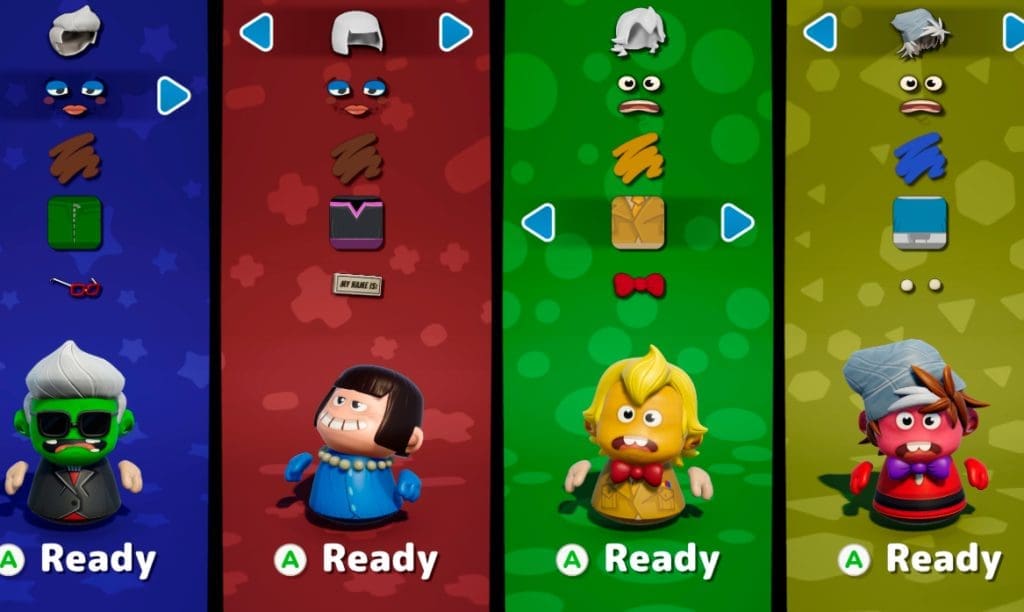
The experience also puts significant emphasis on player identity. Before the actual board game begins, players can customize their avatars using different visual options. Hairstyles, accessories, clothing and other customization elements allow players to create characters that either resemble themselves or intentionally look completely different.
For a family-oriented game, this is an important addition because personalization can make children feel more connected to their digital character. Rather than immediately becoming an abstract game piece, each player can create an avatar that represents them within the game world.
From Classic Tokens to Playable Characters
The traditional Monopoly board game has always had iconic playing pieces, and Monopoly Junior includes a digital interpretation of this idea. Players can participate in a mini-game to select their favorite icon, competing to choose among recognizable options such as the Toy Ducky and Little Scottie the dog.
This seemingly small feature plays an important role in recreating the identity of Monopoly on screen. The developers are not simply reproducing the board and replacing pieces with generic avatars. Instead, familiar Monopoly elements become part of a broader digital world.
Family Gaming Without Unnecessary Complexity
What impressed me most during the Gamescom presentation was the apparent attention given to the difference between making a game simple and making a game simplistic. Monopoly Junior is clearly designed to be accessible, but the presentation I saw suggested that accessibility is achieved through the structure of the experience rather than by removing everything that makes the game interesting.
The interface, visual feedback and interactive mechanics all work toward the same goal: reducing friction for younger players. A child does not need to understand complicated menus or a large collection of interconnected systems before being able to participate. At the same time, there are enough decisions, competitive mechanics and random events to keep older family members engaged.
Designed for Different Skill Levels
That balance could be particularly valuable in family gaming environments where players have very different levels of experience. A parent or older sibling can understand the strategic implications of property collection and chance mechanics, while a younger player can participate primarily through the game’s more immediate actions.
The result is potentially a shared experience in which players do not need identical levels of gaming knowledge. This is one of the areas where the digital format can provide an advantage over more traditional games: the software can communicate information visually and automatically handle many of the calculations and game-state changes that would otherwise need to be managed manually.
A More Active Take on Family Game Night
The developers are clearly positioning the game as more than a digital replacement for a physical board. The colorful environments, interactive dice, avatar customization and mini-games are intended to create a more energetic family experience.
That distinction matters because digital family games compete not only with other games but also with traditional family activities. By adding motion, interaction and visual feedback to the Monopoly Junior formula, the game can potentially make the familiar experience feel new even to families that have already played the tabletop version.
Nostalgia for Parents, Accessibility for Children
For parents who grew up with Monopoly, the game also offers a strong nostalgia component. The fundamental ideas remain recognizable, while the presentation is redesigned for modern digital platforms.
For children, however, the experience does not depend on nostalgia. The colorful characters, interactive environments and simple rules can function independently as an introduction to the Monopoly universe. This creates an interesting generational bridge: parents can recognize familiar elements while children experience them as part of a new digital game.
Why the Gamescom Presentation Left a Strong Impression
Seeing Monopoly Junior during my Gamescom meeting gave me a much better understanding of the philosophy behind the project than simply looking at screenshots or a feature list would have provided. The most convincing element was the way the different mechanics appeared to work together rather than feeling like disconnected features.
The dice interaction, property collection, character customization, mini-games, chance cards and evolving 3D board all contribute to the same objective. They make the traditional Monopoly Junior formula more interactive while keeping the basic concepts understandable for young players.
A Family Game I Am Looking Forward to Playing
After seeing how the game has been adapted for children, I was particularly impressed by how much effort appears to have gone into avoiding unnecessary complexity. A game aimed at younger players can easily become either too simplistic or too complicated, especially when translating a traditional strategy board game into a digital environment.
From what I saw at Gamescom, Monopoly Junior appears to be targeting the middle ground. It retains competition and decision-making, but presents those systems through approachable mechanics and strong visual communication. That is exactly the kind of design approach that can make a family game work across different generations.
Launch and What Comes Next
Hasbro Games Junior Collection is scheduled to arrive on November 6, 2026, bringing the digital Monopoly Junior experience to families looking for a colorful and accessible multiplayer game. Its combination of recognizable Monopoly mechanics and interactive digital features gives it a distinctly different identity from simply playing the physical board game.
For younger players, the experience offers an approachable introduction to property collection, strategy, chance and competition. For parents and older players, it provides familiar Monopoly foundations wrapped in a faster and more interactive presentation. The key question will ultimately be how well these elements work together during extended family sessions, something that cannot be fully judged until the game is played at home.
Summary
My Gamescom meeting with Hasbro Games Junior Collection and Monopoly Junior left me very positively impressed. The game takes a familiar family formula and expands it with interactive dice mechanics, a colorful 3D board, property progression, chance cards, avatar customization and competitive mini-games, while carefully avoiding the unnecessary complexity that could make a strategy-focused game difficult for younger players. What stood out most was the clear focus on making children active participants rather than simply simplifying the traditional Monopoly experience. The result looks like a digital family game designed to bring different generations together, combining the nostalgia of Monopoly with a more modern and playful structure. After seeing how well the game appears to accommodate younger players while still retaining meaningful gameplay mechanics, I am already looking forward to trying Monopoly Junior with my family when it launches on November 6, 2026.