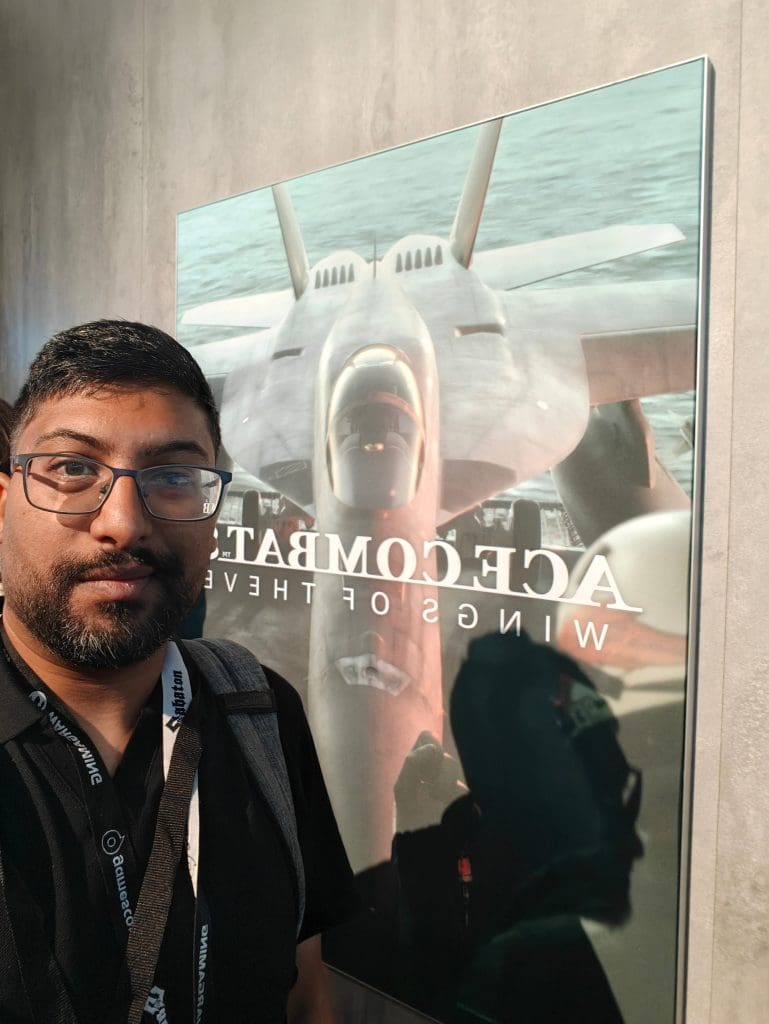
Gamescom is full of games that I want to play, but ACE COMBAT 8: WINGS OF THEVE was different for me from the moment I walked into the meeting. Aviation has been part of my life for as long as I can remember. My father served in the Air Force for close to 30 years and today continues working in the defense industry, including in the aviation field. I grew up in a house where aircraft were never just machines you saw in movies. During school holidays, my father would take us to the Air Force Museum, and during the year there were occasions when he took us to his base and we could see where he worked. Sitting down at Gamescom 2026 and getting my hands on the next mainline Ace Combat therefore felt strangely personal. I was not simply approaching it as another journalist moving from one appointment to another. For a few minutes, I felt like the kid who used to stare at military aircraft and try to understand what made each one different.
A Familiar Ace Combat Formula With Much More Information Around the Pilot
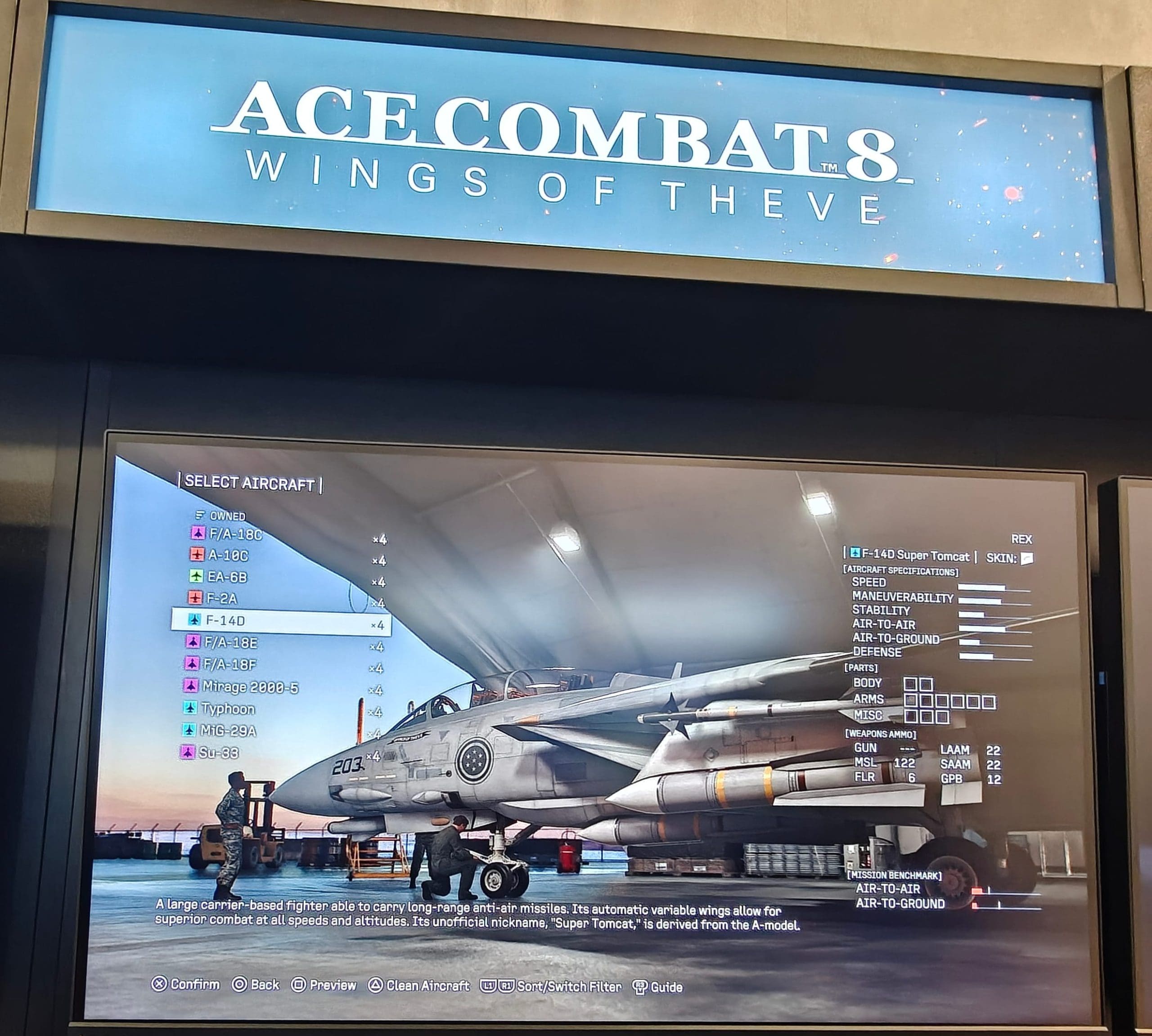
The playable Gamescom build immediately showed how much information ACE COMBAT 8 is willing to put in front of the player without turning itself into a hardcore flight simulator. The aircraft selection screen alone gives a surprisingly useful technical overview. The build included aircraft such as the F/A-18 family, A-10C, F-2A, F-14D, Mirage 2000-5, Typhoon, MiG-29A and Su-33. Selecting the F-14D Super Tomcat, for example, presented performance categories including speed, maneuverability, stability, air-to-air capability, air-to-ground capability and defense. The same screen also exposed customization slots divided between body, arms and miscellaneous categories, alongside weapon information for the aircraft’s gun, standard missiles, flares and additional special weapons. It immediately gives the impression that choosing an aircraft will not simply be about picking whichever fighter looks coolest. The mission, weapon configuration and the aircraft’s strengths should all matter.
Once airborne, the interface becomes much cleaner. The HUD displayed speed, altitude, radar information, current weapon ammunition, flare count and aircraft damage, while keeping enemy and friendly information readable in the middle of a very busy battlefield. During the demo I could see standard missiles alongside specialized options such as 6AAM and QAAM, which reinforces the importance of adapting the loadout to the mission rather than relying on one weapon throughout the entire sortie. The control station at Gamescom also displayed separate Standard and Expert control configurations, which is important for a series that has always needed to balance newcomers with players who want more direct control over pitch, roll and aircraft orientation. The setup confirmed versions for PlayStation 5, Xbox Series X|S and PC through Steam, with the Gamescom signage pointing to an October 2, 2026 release.
The Mission Briefing Made the War Feel Larger Than the Dogfight
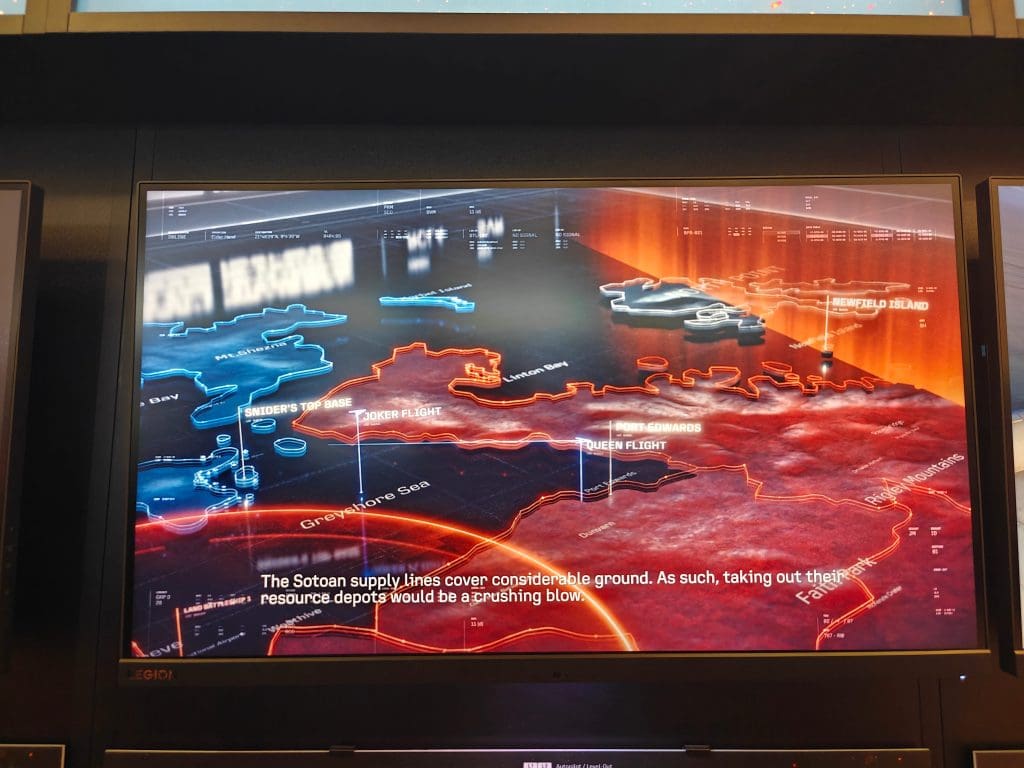
One of the parts that caught my attention most was actually what happened before the shooting started. The mission briefing used a detailed three-dimensional tactical map showing islands, coastlines, bases, naval forces, ground units, flight paths and enemy-controlled areas. Locations visible during the briefing included the Greyshore Sea, Port Edwards, Newfield Island and Snider’s Top Base, alongside formations such as Joker Flight and Queen Flight. The briefing was not just decoration before pressing Start. It showed Sotoan supply routes, concentrations of enemy ground forces and naval units, then explained how disrupting those logistical lines could damage the enemy’s ability to sustain operations. Another section of the mission called for neutralizing ships and an air fleet before they had time to react. That structure gives the sortie a sense of military context instead of presenting the player with an arbitrary collection of targets.
That detail mattered to me because aviation was always explained differently in my house. I grew up understanding that a fighter aircraft is only one part of a much larger system involving maintenance crews, intelligence, logistics, bases, communications, planning and countless people on the ground. Seeing ACE COMBAT 8 frame a mission around supply lines, fleets, air groups and strategic targets connected with me immediately. Then the game sends you into the sky and returns to what Ace Combat does best. In the playable section I flew above an enormous ocean environment while the HUD constantly fed me tactical information, radio communications played during the sortie, and targets appeared across the radar. The transition from a dense operational map to the relative simplicity of looking through the HUD and deciding which target to attack works extremely well. It gives context to the action without slowing down the actual flying.
Why This Gamescom Demo Meant More to Me Than a Normal Preview
There is also something special about seeing an F-14 on the aircraft selection screen when you grew up loving aviation. The F-14D Super Tomcat is visually unmistakable, particularly because of its variable-sweep wings, and the game presents the aircraft with enough visual and technical detail that I spent longer on the selection screen than I probably needed to. That was part of the fun. I was looking at the aircraft not only as a collection of gameplay statistics, but as machines I had spent years reading about, seeing in museums and discussing at home. The aircraft models, weapon pylons, missiles, carrier environment and cockpit-related presentation all contribute to that feeling. ACE COMBAT remains an arcade-oriented combat game rather than a full flight simulator, but that distinction is exactly why the series works. I do not need to spend half an hour programming an aircraft before takeoff. I want enough authenticity to recognize the aircraft and understand its role, followed by the freedom to push it into spectacular situations that would be impossible or irresponsible in reality.
My Gamescom 2026 session with ACE COMBAT 8: WINGS OF THEVE was therefore one of those rare previews where separating the professional experience from the personal one was almost impossible, and I do not think I would want to. From the tactical mission presentation and detailed aircraft selection to the readable combat HUD, weapon options and large-scale aerial battles, the demo gave me exactly the combination I hoped to see: recognizable military aviation wrapped inside the fast, dramatic identity of Ace Combat. There is still a lot I want to see before judging the complete game, especially how aircraft progression, customization, mission variety and the full campaign develop over many hours, but my first experience left a very strong impression. For someone who grew up visiting an Air Force museum during vacations, walking around a military base where his father worked and living in a family where aviation was always part of the conversation, finally sitting at Gamescom and flying one of these aircraft in ACE COMBAT 8 felt like completing a small circle that started many years ago.