Going into my Gamescom 2026 meeting for Total War: WARHAMMER 40,000, I had a very different level of curiosity than I normally have before a strategy game presentation. I have been playing Total War with my brother for years, and during the last couple of years we have also fallen deep into the Warhammer 40,000 universe, so seeing these two worlds finally come together felt personal. I had the chance to see the game in action, study the battle interface, learn about the technology behind it and later sit down with David Petry, Battle Product Owner, and Joy Dey, Tutorial Lead Designer at Creative Assembly. What became clear very quickly was that Creative Assembly is not simply taking Total War: Warhammer and replacing swords with bolters. This project is forcing the studio to rethink how Total War handles projectiles, battlefield readability, ranged combat, controls, scale and even the technology underneath the series.
Warcore Is More Than an Engine Upgrade
One of the most important things shown during the presentation was Warcore, Creative Assembly’s new engine and the technological foundation for the next generation of Total War. The presentation connected Warcore with next-generation visuals, deeper strategy and the ability to bring the full Total War experience to consoles. That last part matters because Total War has traditionally been designed around mouse and keyboard controls, dense interfaces and a huge number of simultaneous commands. During my interview, Petry explained that the goal is not to simplify the tactical experience for controller users. Creative Assembly wants players to be able to choose how they play without reducing the strategic depth of the game, drawing on experience the studio gained from previous projects where complex strategy controls had to work outside the traditional PC environment.
Warcore also makes more sense when you look at what the battlefield is actually asking the engine to process. Petry explained that projectiles are not simply visual effects placed between a weapon and its target. Every bullet is simulated, travelling along a trajectory and eventually interacting with something in the battle. That sounds like a small technical detail until you look at the scale of a Total War battlefield filled with Space Marines, Astra Militarum, Aeldari and enormous Ork forces firing simultaneously. Creative Assembly had to re-engineer major parts of its systems to support that volume of ranged combat. Cover therefore becomes far more important than it has been in many previous Total War games. The developers are effectively introducing the logic of a heavily ranged Warhammer 40,000 battlefield into a game expected to handle the enormous unit counts associated with Total War.
Space Marines, Orks and a Much More Tactical Battlefield
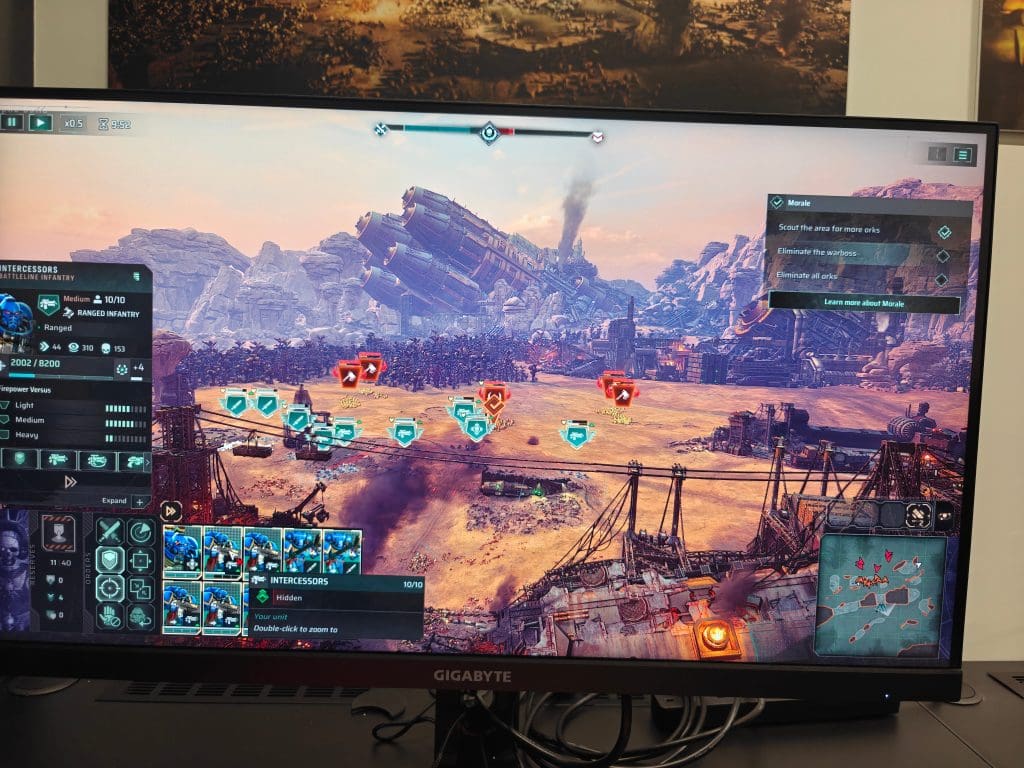
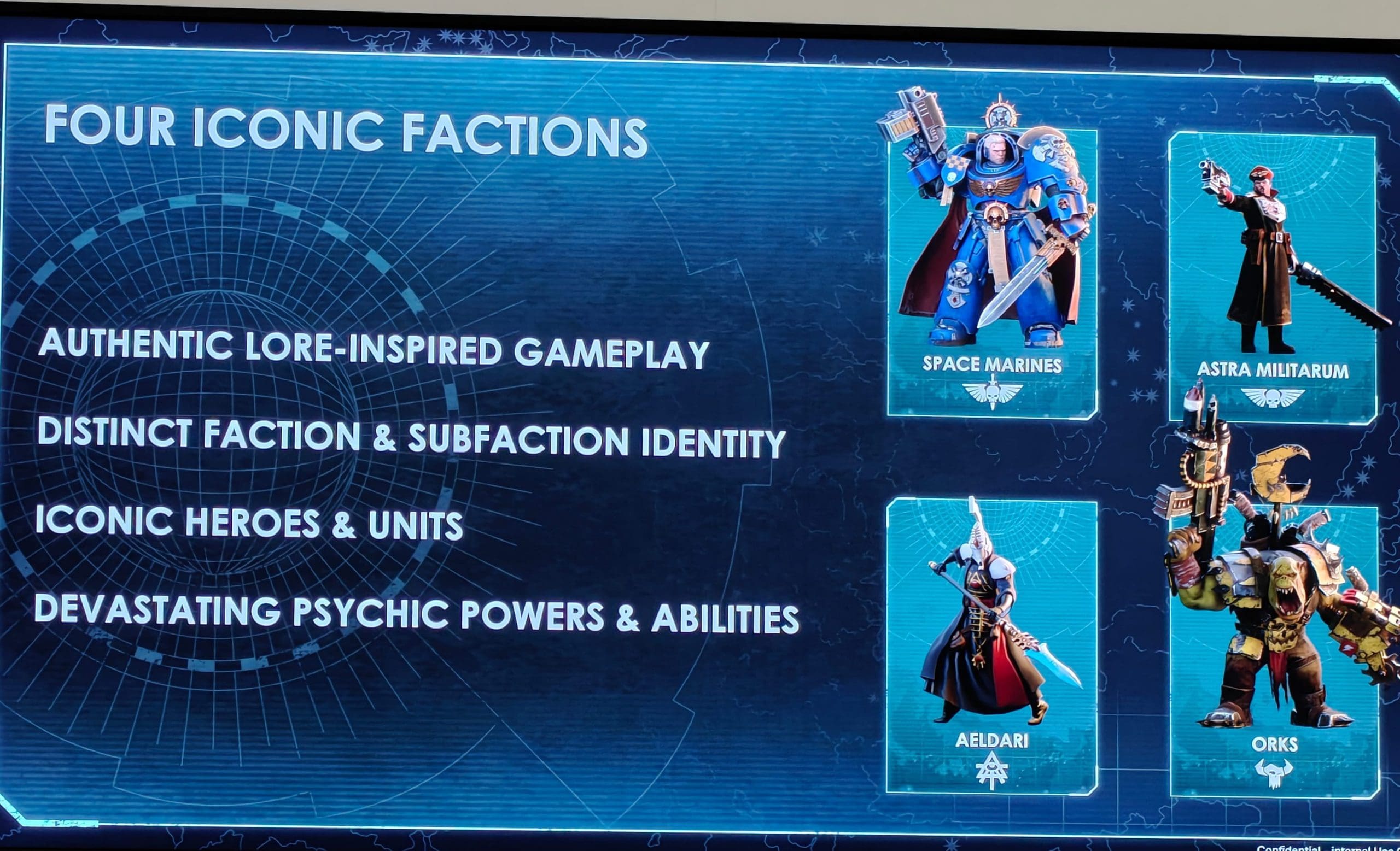
The build I saw showed four major factions: Space Marines, Astra Militarum, Aeldari and Orks. Creative Assembly specifically highlighted authentic lore-inspired gameplay, distinct faction and subfaction identities, iconic heroes and units, and powerful psychic abilities. During the hands-on material, the Space Marine Intercessors provided a good example of how granular the new combat systems can become. An Intercessor squad was displayed as a 10-member Battleline Infantry unit classified as Medium and Ranged Infantry. The interface separated its effectiveness against Light, Medium and Heavy targets, immediately showing that weapon selection and target priority will matter. Unit cards also included detailed numerical statistics, health values, command options and status information such as Hidden, suggesting that concealment and battlefield positioning are going to play an important role alongside raw damage output.
The command system reinforces that impression. One tutorial specifically introduced Fire at Will, allowing ranged units to automatically engage enemies entering their firing range and redirect fire toward another viable target when the original target moves away. The interface also contains a dedicated Orders panel, reserves information, a tactical minimap and a prominent battle progress indicator. Morale is another mechanic the game teaches directly. In the scenario I saw, objectives included scouting for additional Orks, eliminating a Warboss and eventually destroying the remaining Ork forces. Another section required defeating multiple waves of Orks. This makes the battles feel more structured than a simple clash between two armies. There are battlefield objectives, reinforcement-style systems, specific priority targets and scenarios that can evolve while the battle is already underway.
Creative Assembly Is Designing for Chaos Without Losing the Player
The sheer scale was probably the most impressive part of seeing the game running in front of me. Large formations of Orks filled huge sections of the battlefield while multiple Space Marine squads were spread across a wide desert environment dominated by industrial structures, smoke, fire and the wreckage of an enormous spacecraft. Yet Creative Assembly clearly understands that putting more units and more gunfire on screen creates another problem: readability. Petry explained during our interview that the team is using lighting and color systems that change depending on camera distance. When the player zooms out, colors can be adjusted to make opposing forces easier to distinguish. Zoom back in and the presentation returns to a grittier, more natural look. Even combat feedback is being designed around clarity, with different visual treatment intended to help players understand whether an attack is particularly effective or weak.
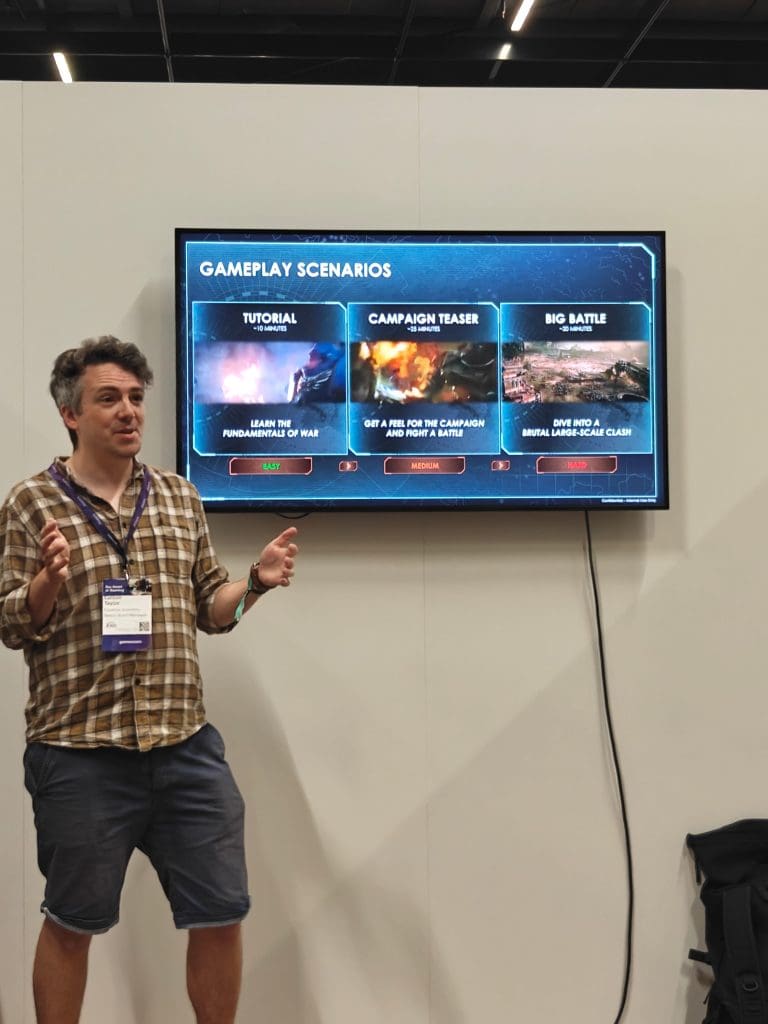
That philosophy extends directly into the tutorial design. Joy Dey explained that the team broke the experience down into individual lessons rather than immediately overwhelming new players with the enormous number of Total War and Warhammer 40,000 systems. The gameplay scenarios shown at Gamescom reflected exactly that structure: an approximately 10-minute Easy tutorial, an approximately 25-minute Medium campaign teaser combining campaign gameplay with a battle, and an approximately 20-minute Hard large-scale battle. Dey’s approach is to let players learn mechanics by experiencing their consequences. Put a player in a bad position, let incoming fire demonstrate why cover matters, then introduce hidden Orks and force the player to understand flanking. For me, this was one of the strongest signs that Creative Assembly knows how difficult this crossover is. Total War veterans need enough depth, Warhammer 40,000 fans expect the universe to behave correctly, and newcomers still need to understand what is happening without reading a manual before their first battle.
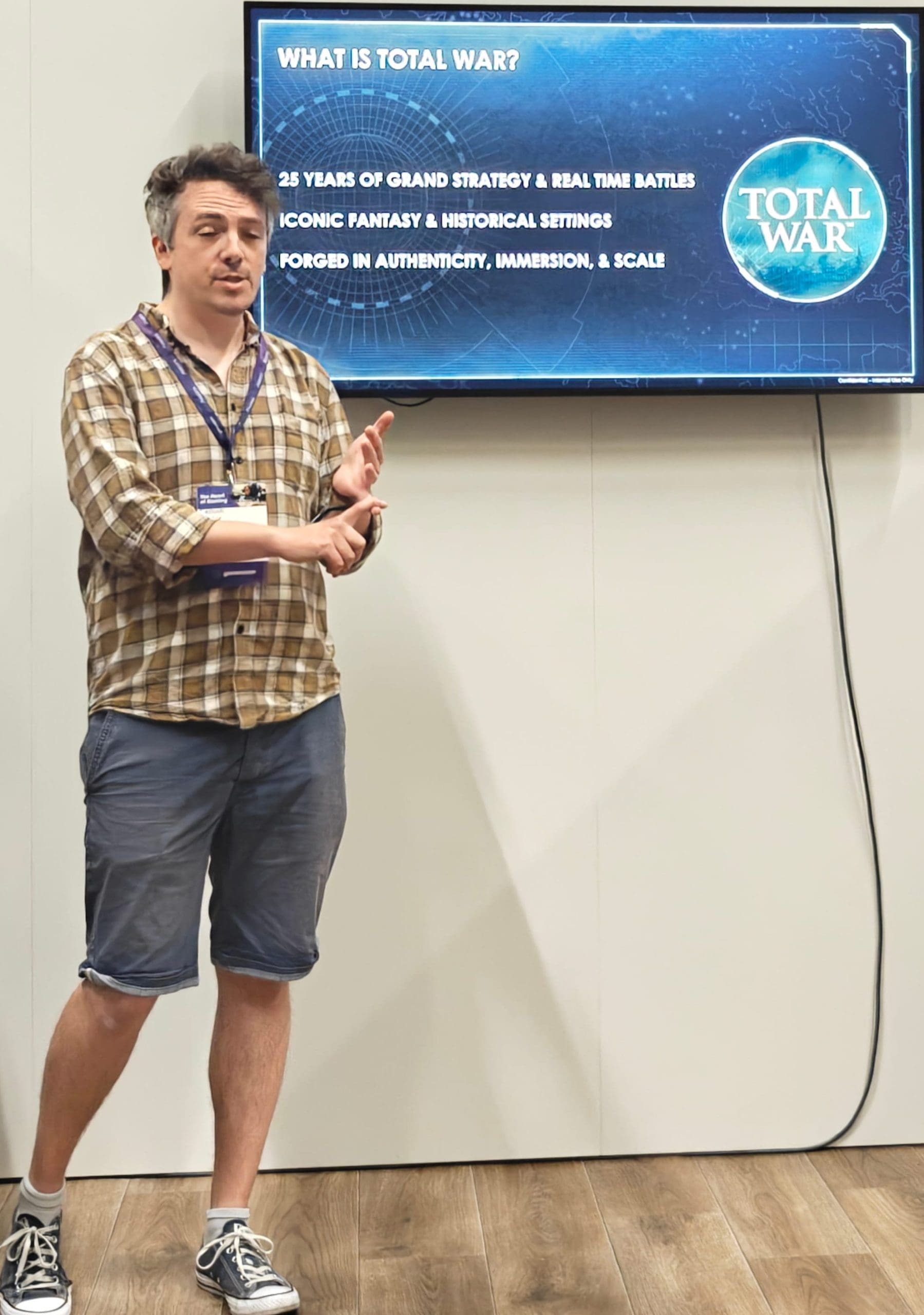
After seeing Total War: WARHAMMER 40,000 at Gamescom 2026, I came away believing that its biggest challenge is also what makes it so interesting. Creative Assembly is trying to preserve the grand strategy, real-time warfare and huge scale that have defined Total War for more than two decades while rebuilding major systems around the realities of Warhammer 40,000 combat. Warcore, individually simulated projectiles, meaningful cover, Light, Medium and Heavy target classifications, Fire at Will behavior, morale, concealment, reserves, psychic abilities, battlefield objectives and enormous numbers of units all point toward a game that is changing the Total War formula rather than simply reskinning it. There are still major questions about the full campaign, faction depth and how all of these systems will interact over dozens of hours, but after seeing it running and speaking directly with the people building it, this is now one of the strategy games I am most interested in following.